Saturday, April 1, 2017

16 Days in India - Challenges Abound

It's been over 20 days since I last updated. And our time has been spent sort of adjusting, and sort of fending for ourselves. As I sit draft up this post we are sitting in a the peace, quiet, and serenity of Mrauk-U, Myanmar (pronounced /mrauw-oo/), which is quite the opposite of the chaotic, loud, impatient, and disturbing country of India.

Again, due to the time elapsed since my last post, this will be a batch read. In other words, I'm compiling all my thoughts only chronological to the extent that I thought them and possibly in connection with our travel days (New Delhi > Vrindavan > Mathura > Agra > Jaipur > Goa > Mumbai).

----------------------------------------

3 hours into New Delhi, and a failed but elongated scam attempt has occupied 2 hours in the middle of the night upon our arrival. Long story. Ask me about it if you really want to hear the details.

----------------------------------------

India is a true 3rd world country. I've never been anywhere quite like this. And I think that the state of this country is so unfortunate, and my experience is so eye-opening.


----------------------------------------

Why is there so much dust in this country? It is so hard to breathe. Why don't people clean the streets? Why does everyone just spit and pee everywhere?

----------------------------------------
Vrindavan & Mathura, India

Known as the birth area of the god Krishna (born in Mathura, spent his childhood in Vrindavan), these towns are kind of like pilgrimage areas for devout Hindus.  We are spending our Holi festival here, and it's chaos. People are everywhere and so are all the colors of the rainbow. The streets are jammed with people. We spent some time on a rooftop to avoid the colorful tornado below. But it's inevitable. You have to walk through the craziness and you get doused in color. After 3 minutes in the streets, you look like a Skittles bag was melted over your head. And it's not like people just throw the colored powder, they also wipe it on your face. So you have like a million peoples' handprints all over your body.


----------------------------------------

One of the most disgusting things we did in our lives happened in Mathura.

As a practice, Hindus do not wear footwear into the temples. This is not uncommon in other religions, like Buddhism, or even common practice in an Asian household.

On one morning, we met an Indian couple headed out early in the morning, same as us. We ended up sharing a tuk tuk to the temples, and they offered to let us tag along and they would help us with the language barrier and give us some insights. Wonderful! They were a great couple who really went out of their way to assist us. So we took them up.

We hired a tuk tuk for the day at a fixed price. He would drive us everywhere and wait for us to visit each site. At the very beginning of our tour, the wife advised us to remove our shoes and just walk around barefoot. Granted, many other people were barefoot, so it made some sense. BUT, if you saw the streets in Mathura, I'm pretty sure any first world person would vomit at the idea.

Aaaaaand we DID it!

We walked on the dirt roads, the cobblestone, the gravel full of dog urine, human urine, cow feces, chicken shit, pig poo, goat's milk, snot, spit, water, colors, garbage, cigarette butts, food waste, beer bottles, Kingfisher cans, and all the other wonderful, disgusting, puke-worthy things in this world... BAREFOOT! 

Gross!

----------------------------------------

Has religion held this country back from progressing and becoming an advanced nation? Many people worship animals still and vegetarians force all the tourists to give up meat while on holiday as well. The restaurants are generally vegetarian and very few serve any kind of meats.

----------------------------------------

Animals just roam the streets freely. There are no herders (as far as we could see). Cows, goats, pigs, boar, dogs, monkeys...they are untamed and wild in India. It causes traffic. They leave poop everywhere. And the monkeys steal random things from passers-by.

----------------------------------------

Agra, India

Agra is most well known for the Taj Mahal and the different forts and other such architecture of different time periods. The Taj Mahal is certainly grand and a lovely gesture of a King to his wife. But in my opinion, the hype is overrated. The structure is beautiful. But the waiting, the lines, the security and all the hassle associated with the Taj is nonsense. When you actually get to view the mausoleum, it's not really that impressive inside. And the guards just hurry you around the tomb and out the door again.

I'd say it's worth seeing the Taj Mahal from the outside and from afar, but I wouldn't say it's necessary to get within the walls and gates. Sure, there's a reflection pool, but you can get photos just as beautiful from the garden on the back side across the river.

I don't regret going at 5AM, but you don't really get to a see a sunrise because the gates don't open until after the sun actually rises. So that's not worth it. Just go in the middle of the morning when there's no line to get in.


----------------------------------------

Like everything else in this country, security at the train station is fake. They have bag scan machines and metal detectors, but they are unmanned and no one checks anything. We literally walked thru the gate without taking off our packs or scanning anything. Pretty ridiculous. Also, people just cross the tracks randomly between platforms without care for trains entering the station. If a train rolls in, the people just stand in between the tracks and allow the trains to cross behind and in front of them.

Coincidentally, the day after this thought 2 bombs went off in/near the Agra Cantt train station, which we were just in yesterday. Thank god we weren't there.

----------------------------------------

I admire solo women travelers. They have so much courage and adventure in them. It takes so much to travel around the world by yourself. You have no one to support you along the way. You have no help from a trusted friend. You have no shoulder to cry on when you struggle the most. I could never travel by myself, which is why I am so happy to have my beautiful wife accompany me to the most remote parts of the earth.

----------------------------------------
Jaipur, India

Jaipur is such a different city than the other North Indian cities we've visited so far. It's almost like we've traveled through time as we've passed through the cities. Each city we've navigated through has progressively gotten better. In a clockwise manner, from Vrindavan to Mathura to Agra, and now to Jaipur the situation has improved drastically. We could very well have been in the early 1900s in Vrindavan and worked our way to the present in New Delhi.

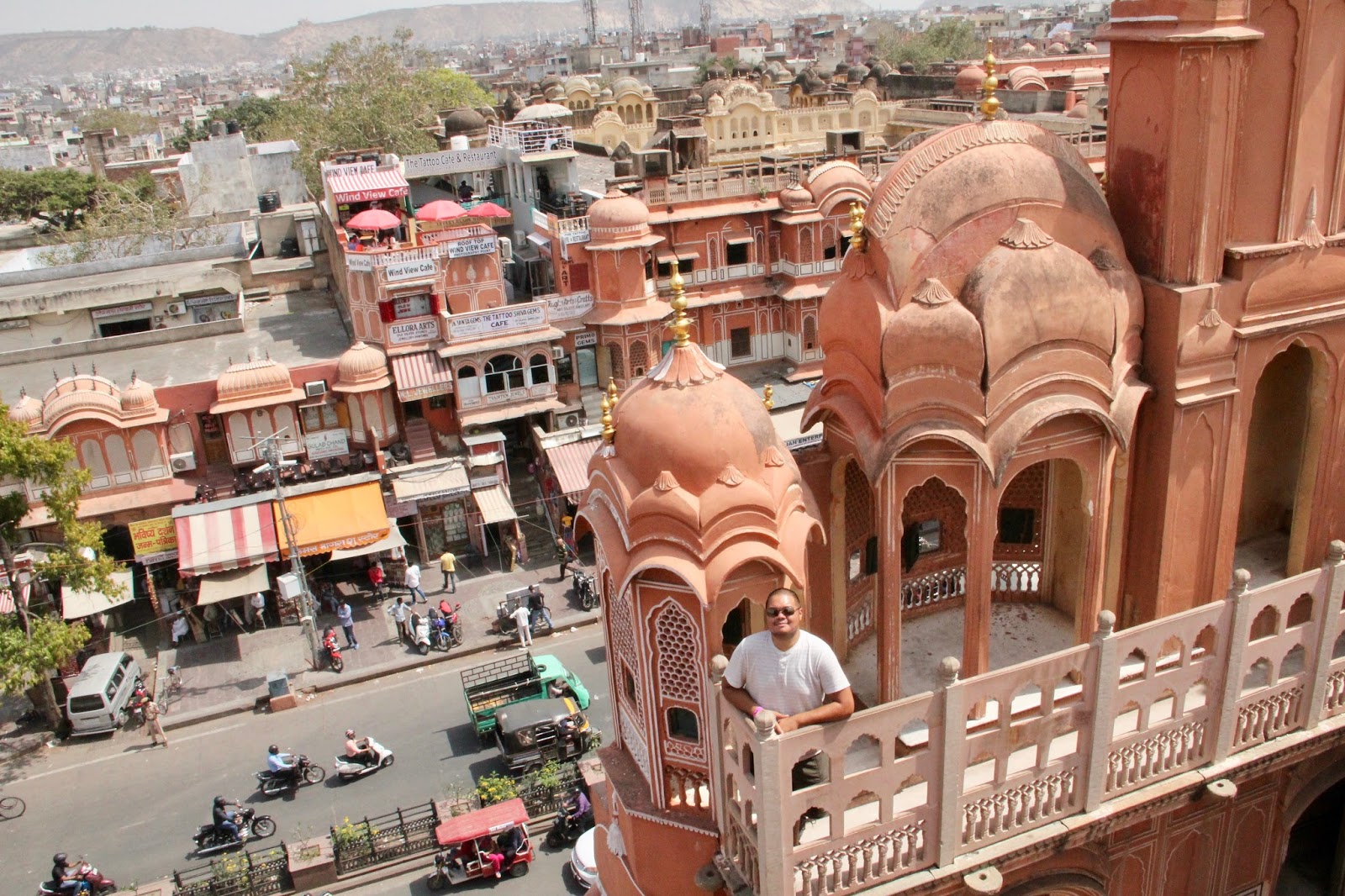
Jaipur, the Pink City, is so much more relaxed. The Hawa Mahal is the most interestingly designed building in the city. It makes you think that there were so many women hiding behind all the windows looking down on the city. It was fun to walk around and peer through each window and catch a glimpse of every woman's view of the street below her.

Rooftop of the Moustache Jaipur


Inside the City Palace

Albert Hall Museum

Pigeon watching outside of Albert Hall Museum

Hawa Mahal

Hawa Mahal from the front of the street

One of the many windows of the Hawa Mahal

One of the beautiful women in the window


----------------------------------------

In between the big cities in the Golden Triangle there is literally nothing. The small towns which the trains and buses pass look poor and old and unkempt. The land is empty, unused. It is dry, arrid, and extremely dusty. There is little sign of farm life and so few houses and people.

----------------------------------------

The trains are unbelievably long and seem to only be pushed/pulled by a single engine. How can that be efficient?

There must be stowaways on the trains. It's impossible for officials to check tickets for all the lower class passengers. And they practically stuff themselves in each of the lower class train cars. It's a sight to see but must be a pain to check. Why even bother?

----------------------------------------

The roads are fairly decent. But the drivers of the buses are a bit erratic and unsafe. There's plenty of speeding, abrupt braking, and enough  swerving to compete with an amusement park ride.

The use of the horn is far more excessive in this country than anywhere else we've been, even Vietnam.

----------------------------------------

We were never able to get off the waitlist for our Jaipur to Delhi train so we ended up canceling and riding the bus. The bus was quite easy to get a ticket for and ride. Surprisingly it was better than the train in our opinion. And in between Jaipur and Delhi are much more life and establishment. The closer you got to Delhi the more buildings and life you could witness popping up. And just outside of Delhi city are all the businesses possibly setting up their real CBD, we don't know.

----------------------------------------
New Delhi, India

Some Indian people are amongst the most unruly people we've ever met. Many are unbound by rules and regulations. Many have no care for courtesy. People just cut lines, push, and interrupt.

----------------------------------------

Traffic is awful.  No one follows the traffic rules. The lines on the road are useless. And honking of the horn is incessant. It's so unnecessary. The road could be wide open and bikes and cars could still honk at nothing. It's annoying. It's noise pollution.

----------------------------------------

Nothing runs on time. Trains never come or go at the correct times. All the station can do is apologize. But what good is that? Just fix the process.

----------------------------------------

The worst part about the entire experience is the lying and cheating people. It is rampant and no one stops it.

----------------------------------------

Auto rickshaw drivers are much better than many of the taxi drivers in Delhi. They give you a tourist price but once you negotiate them down to a reasonable price they agree and take you to your destination. The taxi drivers are a mix of touts and thieves trying to scam you for more money. The rickshaw drivers don't have time for that nonsense. They need passengers and they need to move then repeat.

----------------------------------------

I'm so unimpressed with Delhi for so many reasons. It's overcrowded. There are so many liars, cheaters, thieves, and con artists. The city is unbelievably dirty for a capital city. It's too big geographically and makes getting from one place to another more challenging especially due to traffic. The roundabouts are also mostly useless when there is a traffic cop trying to screw up the traffic pattern thinking he has a real job there. The police are as corrupt as the thieves on the street. They know of all the touts and scams but they would rather get paid off to look the other way. You don't know what kind of officer you are getting in the streets of Delhi.

----------------------------------------
Goa & Mumbai, India

South India, particularly Goa and Mumbai, have really saved this country's reputation and probably it's financial well-being.

Goa is a diverse coastal region on India's west coast on the Arabian Sea. Although the sea is not so great for swimming, the location is fantastic for seafood and climate.

I would know more about Goa except for the fact that I was practically bed-ridden from a terrible bout with LBM for 2 of the 3 days we spent in this warm-weather region. But on the day we did venture out, we experienced the simple beauty of the small shops in the walkable neighborhoods in North Goa. We strolled along the streets of Anjuna and Candolim and meandered towards the beach and shoreline for quick glimpses of the swimmers at sea. The feeling of peace comes with the waves lapping at the sand and a calmness engulfs the area.

It should be noted that we really treated ourselves with a stay at the Grand Hyatt Goa and couldn't have been more impressed with their service and quality. It was the most comfortable we've been (despite my time spent on the throne) during this whole trip. I couldn't have been happier to be sick in a place like this.

The Grand Hyatt Goa Resort


Small shops on the road in Candolim, North Goa

Beach in North Goa

Dusk on the Arabian Sea


----------------------------------------

Mumbai should be the capital of India. It has rules, and they are abided. It has structure, and it works to maintain the peace and civilize the people. The city has character and history, which give the city a sense of pride. Mumbai has shopping, siteseeing, transportation, and color that give people a reason to visit.

We did a half day city tour to see the livelihood of the people. We experienced the different neighborhoods from the wealthy to the not so wealthy in finance. Cars from all classes perused the streets. People from all walks cruised the walkways and road-sides. And people paid us no attention, which was fantastic. The art deco of Mumbai was reminiscent of Miami, FL. The lively streets in the evenings reminded me of the Lower East Side in Manhattan. The cricket grounds were like the Meadowlands in NJ.

It was interesting to see the largest washing laundry areas in Asia. All of those families had a job and were doing it to the best of their ability. It's a dirty job in some cases, but they were for the cause. And the effect was that although they were not rich by any standards, they still had things to show for (ie. satellite tv, cell phones). Despite not having cars or houses to prove their success, these people are content with what they have in the conditions that they have them in. It's somewhat admirable.


I think what I was most impressed about in Mumbai was the dabbawalas. These delivery men are some of the most admired in the city. It is their job and duty to deliver meals prepared and bagged by the husbands and wives of the working class to their spouses in the office. It is often said that the dabbawalas make no mistakes in their deliveries of the 100s of 1000s of lunchboxes daily. They even return the lunchboxes to their origin after lunch. And everything is done manually. Meaning, they ride bicycles, trains, rickshaws, or pushcarts to get it all done. Nothing of their process is motorized. It's an amazing system. If only all delivery people were as prideful, accurate, efficient, and courteous in their work.


I would highly suggest anyone to visit the city of Mumbai for what it has to offer because Northern India is a mess in my eyes and is overrated. If you must visit New Delhi or the Golden Triangle, take a guided tour, pay up, and get out as fast as possible. It's not worth the hassle.

----------------------------------------

We did a half day slum tour, and actually it was impressive. I was impressed by the ability to live in such conditions. I was impressed by the fact that so many people had jobs yet the literacy rate is so low. I was impressed with how large the area was and how many people lived in this community. I was impressed with our tour guide who was 18 years old who grew up in this neighborhood who got out through education and was studying engineering in University currently. With him, we had the ability to walk deep into the slums. We went into the tiniest spaces where people lived, cooked, brushed their teeth. We saw the communal latrines. We learned where people worked and what kind of jobs they held. We learned a good amount in the 4 hours we spent in the slums. And thankfully, the only thing we got were some looks and never encountered any problems. It's said that the residents are peaceful and do not look for any kind of trouble.

India Gate

Fisherman village

Mumbai skyline

Clock tower in Mumbai that is by the same architect of Big Ben in London

Most expensive house in Asia, occupied by a family of 5 with 100+ servants.

Gandhi bust in the Gandhi House in Mumbai where he often visited. 

Mumbai railway station where a scene from Slumdog Millionaire was filmed.

Thursday, March 9, 2017

Vietnam - The Halfway Point And A Place To Call Home

The following is a series of random paragraphs of thought. This post is not chronological or in any kind of order, but rather a compilation of memories or inner thoughts and ideas of the weeks past. It may be long-winded, so just come back for bits and pieces if you have to. But finish the read. It will make me happy and useful. Haha. There are lots of pictures!

-----------------------------------------------

There is so so much comfort in having someone around who speaks a language not your own in a country they call home. There is a sense of ease when you can call a place your home while on the road and have family take care of you, show you, and direct you to anything you want and desire. There is gratefulness for the conveniences you've been given, and there is a debt of gratitude which is difficult to relieve because the lengths have been so great to which people have gone to make you so welcome and happy.


These are the thoughts and feelings I've had after spending time at my wife's family's home in Saigon (Ho Chi Minh, Vietnam). Her aunts, uncles, and cousins have openly invited and cared for us each day of our stay. They provided advice, food, direction, negotiation, and countless other intangibles to/for us and for our convenience. Their hospitality is boundless. In a way, we are so lucky, because we've been given so many freedoms in a place where freedom is limited. What a dichotomy.

Notre Dame Cathedral of Ho Chi Minh City

Central Post Office designed by Gustave Eiffel (of the Eiffel Tower).

Saigon by night. View from Air 360 Sky Deck in the Ben Thanh area.

-----------------------------------------------

Ho Chi Minh City is full of history. Sadly, however, it's predominantly related to the Vietnam War. Numerous tourist sites offer their version of the war (and its outcome), and it seems a bit controversial. I say this because my wife's family's perspective is that of a Southerner (the North won, obviously). The stories they've heard about the war and fleeing communism are completely opposite of anything depicted in the museums. The emotions that were evoked were strong. My wife, her cousin, and other family member expressed their disgust with how the Southern perspective was completely omitted from history. But I guess that's what happens when you lose. Your story is untold and hidden from the history books or any other form of documentation. This is where storytelling and word of mouth flourish. It's the only way a life's experience can be relayed for the future generations. It's the only way some truth (and, of course, opinion) about the past can be shared for others to learn from. But textbooks will certainly differ. So as my dad always said to me, "there's always two sides to a story" and that's why you must take everything "with a grain of salt."

-----------------------------------------------

Riding around on a motorbike in Ho Chi Minh City is really intense. The sheer amount of people in the streets at any given time of the day is amazing. Cars, motorbikes, bicycles, rickshaws, motortrikes, pedestrians, street food vendors, men, women, children, and even animals all crisscross the streets, intersections, and what's left of the sidewalks. Motorbikes sometimes come up the wrong side of the street while pedestrians and cars play frogger across the road. U-turns can happen at any moment. Cars and bikes swerve to avoid some kind of traffic and everyone behind follows suit. Motorists don't even bother looking before making right turns. Some use turn signals; other use hand signals. The more skillful talk or text while driving their motorbikes with one hand. Most drivers have 1-2 additional passengers riding with them. In some cases, you might even see 4 to a single bike! Some have passengers and goods being transported. You can see anything from boxes of noodles to hoses wrapped around the driver to poles and shovels to 1000 eggs or even some chickens. But somehow everyone maneuvers their way through the chaos mostly unscathed.

Cross street near our Ho Chi Minh City home.

-----------------------------------------------

We did pay a visit to the Cu Chi tunnels to see what it was like for the combatants of the war. I definitely did not fit and didn't bother to try to crawl through. Though Jenn and Carolyn gave it a GO. By their description and by the tour guide's knowledge base, the tunnels are stuffy, tight, and difficult to navigate. They were geniusly constructed otherwise, with plenty of uses besides moving from point A to B underground. There were kitchens with smoke stacks. There were air vents strategically placed. There were labs for building bombs, shoes, clothing, weapons, and other wartime necessities. I found this to be the most interesting war related tourist site we visited albeit still biased for the North perspective.

Demonstration of how small the Cu Chi Tunnels

-----------------------------------------------

The Mekong Delta region of Vietnam is still so poor and living in the past. Modernization is taking its time reaching this Southern area. I don't necessarily understand why either. Is it the government withholding information? Is it the people unwilling to adapt? Maybe a combination of both? Some would say if it ain't broke then don't fix it. But I say, improvement is not necessarily fixing nor is there an identifiable problem. It's just about making lives easier and better. But I suppose there is a large hurdle to overcome. Money.

There is not enough money to make such improvements in this area. And it's fairly evident. As you drive through the neighborhoods from Saigon to this area, there are few buildings or any real infrastructure aside from the 2 lane roads leading to the delta. There are many poorly built houses with poor street stands and vendors along the way. There is garbage everywhere and sanitation is certainly a question.

But where does all the money from tourism go? I have to assume that thousands of people visit this area every day/week/month/year. Why isn't the money spent in this area used to improve this area?

Or do the people here just not care? Are they satisfied with the lives they live? Do they not see a problem? Will this mindset outlive this generation and future generations?

I believe there are people who want to improve. But the the army is tiny compared to the masses of those living at par for the course.

Bridge crossing the river in the town of Ben Tre.

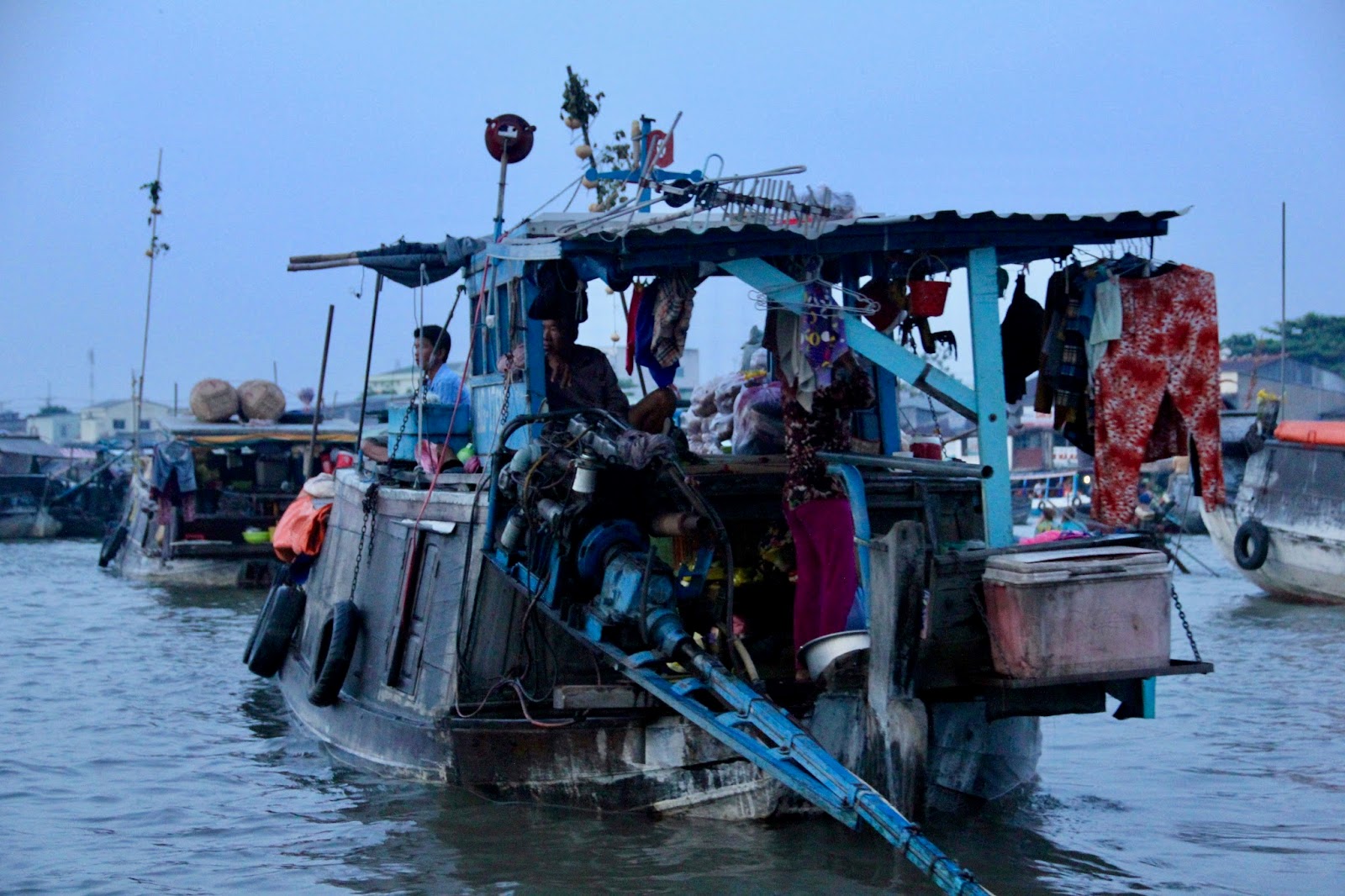
Typical boat on the Mekong River at the floating market.

The bamboo stick with all the goods identifies all the fruits and vegetables this vendor has to sell.

Floating grocery store. 

A happy family vending on the river. 

If you only have 1 product to sell, you can drive your small boat around from boat to boat to make sales. 

Transactions can be done along the shore as well. 

Carolyn, myself, and Jennifer with our tour guide and captain on the Mekong River.


-----------------------------------------------

At one of our homestays in the Mekong Delta region town of Can Tho, we met some really friendly people who have practiced their English and gone to university. They run the homestay that is very popular amongst tourists, and now we know why. It is on a farm in the countryside with Mekong River canal offshoots running through it. The area is peaceful and remote, but close enough to the city and main river docks to take tours. The accommodations are rustic but well maintained with plenty of space and open-air to really absorb nature's finest beauty. In the morning, you hear the crow of the roosters. During the day, you feel the swoosh of the canal waters from the boat vendors. At night, you hear the chirp of the crickets; the darkness is illuminated by the fireflies; and the light breeze rustles the coconut trees and other vegetation.

Our homestay in Can Tho straddles the canals of the Mekong River. We are on our way to the "lobby" for a home-cooked meal. 


Free bikes for use from our homestay.

Boats that are impossible to paddle for any old human. Professionals are required to paddle and navigate the canals. 

So we just used the kayak.


And we got these 2 little pups to play with to boot. On the left is Mekong. And on the right is Delta.


-----------------------------------------------

In the Mekong Delta region, waterside property is not valuable like in the United States. It's where the poorest people live, bathe, wash clothes, and brush their teeth. They survive on less than $100 per month. Meanwhile, property on the Hudson River is in the millions $$$$.


Some people make rice paper from scratch the old fashioned way to make money. 

Rice paper is steamed to be shaped and cooked, but then sun-dried to be ready for sale. 

-----------------------------------------------

There is plenty of French influence in Vietnam. Coffee, pâté, French bread, architecture, even some words. It was funny realize this after a conversation with a local Frenchman.

-----------------------------------------------

The island of Phu Quoc is famous for few things. One is that they produce some of the best fish sauce in Vietnam. The boats go out and fish for anchovies and they are processed at the facility to ferment for one year. The scent is amazing (if you like that old rotten decomposing smell). We learned that the fishermen could be out to sea for indefinite time periods. They have no schedule. One day they will just show up in port and unload and head back out if necessary.


#islandlife


Phu Quoc is also known for their beaches. But to my surprise, they are not so crowded. We saw the beginnings of more beach resorts and other such establishments. Tourism has not taken over this island yet. Our prediction is that in the next 5-10 years, Phu Quoc will be a can't-miss destination for travelers visiting Vietnam. For now, infrastructure is improving; beaches are still somewhat barren and unkept; and there isn't a real good transit system around the island yet. That will change when the big resorts really go full force to attract customers. Apparently, a Marriot is going up on a part of the island. Consider that the beginning of the end of peace, quiet, and rural life on this island.

-----------------------------------------------

We had some really interesting true life discussions about Vietnamese families. One of the conversations we had with a couple of locals was of how the maturity Vietnamese children is so slow in comparison to other children around the world, namely French, American, and Filipino. Consequently, the process for parents to let go of their children is equally slow. The combination causes some strange social issues of empty nest syndrome (for parents) and inability to separate from the parents (for the children).

Much of the cause of this social issue is the culture of families here in Vietnam. There is a respect that must be given to elders (not different from other cultures, but deeper in meaning and value here). There is also the notion of debt of gratitude that is paid back over an entire lifetime. Additionally, there is a fear instilled in the children here by the parents, more-so the mothers, who are always correct and know best. Children then have a difficult time in combating them even when the parent is incorrect or can be taught new/better things and ways of thinking. In my mind, the things that should be so easy are so difficult and adulthood is an elongated timeline. Whereas kids in other countries are up and out of their parents house by age 18, here in Vietnam that doesn't happen until late 20s or even early 30s.

-----------------------------------------------

The types of conversations had around a red plastic table, sitting on tiny, blue, backless plastic chairs for the evening's dinner in Hanoi reminded me of episodes of Anthony Bourdain's No Reservations or Parts Unknown. I've enjoyed all the meals taken alfresco.


-----------------------------------------------

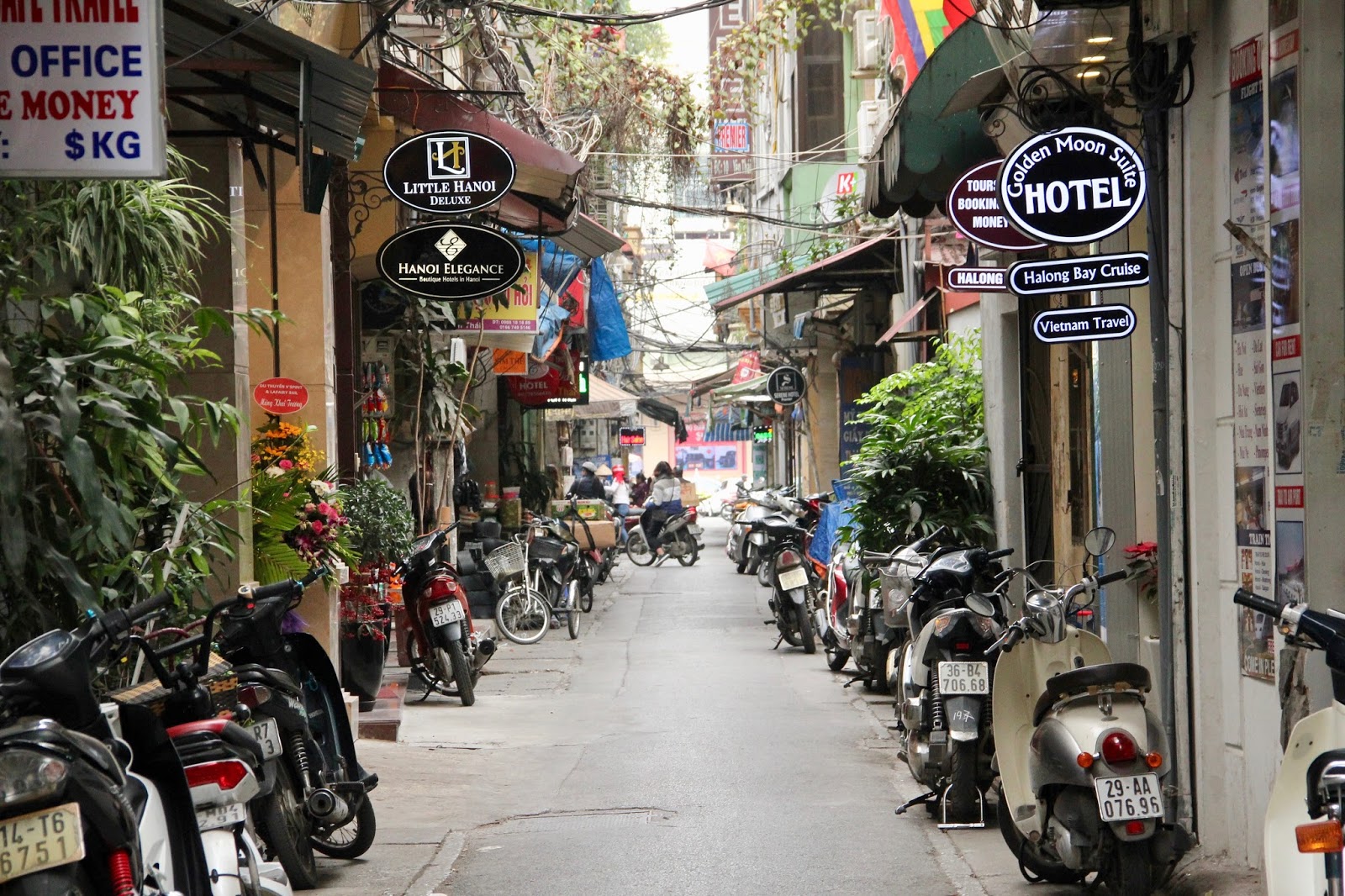
We loved Hanoi! There is a stark contrast between this city and Saigon. It's polar opposite of each other almost. At this time of year, Hanoi is relatively cold (I had to buy sweatpants because I left my pants in HCMC). Saigon has 2 climates - hot and hotter. Compared to Ho Chi Minh City, Hanoi is more calm. Trees line the streets. There is less motor activity. It's easier to cross the street! And the city is much more walkable than Saigon.

The people are quite different too. I felt a more serious tone or matter-of-fact type conversation. It was especially evident at the food establishments and other service related places. But at the same time, I felt like there was a happiness in the people who lived in Hanoi. Every weekend, the roadways that surround Hoan Kiem Lake are closed off to motor traffic and allow only pedestrians. It allows the people to use the streets to convene, play games, perform music and dance, kids to run freely, and food to be sampled all around. It's a real spectacle to see the locals come out and play on an evening during the weekend. Ho Chi Minh does something similar, but on a much smaller scale and only in 1 of the many districts. It also feels more touristy and showy.


Old and young. Traditional and modern. All living side by side in Hanoi. 


A crazy game we watched at the park. It's basically like badminton but with your feet. 


I think my wife and I completely agree that the food in the North is of no comparison to the South. It's better in the South.

-----------------------------------------------


I believe that Vietnamese food in the United States is that of the Southern Vietnamese. And it makes sense. Southerners fled the country and communism. How do I know though? Easy. I ate numerous meals up north. For example, pho is an iconic dish in Vietnam. It probably what they are most well known for in the culinary world, besides banh mi. In the South of Vietnam and in the US, pho is somewhat self-assembled, the fixings I mean. You add lime, hoisin sauce, mints, hot peppers, bean sprouts, hot sauce, and anything else your tongue desires, though those are the basics, in whatever quantity you choose. In Northern Vietnam, you take what you are given. You have no choice. It seems so communist and fitting that it's served that way. They build it; they give it to you. Take it and eat it, or get out. Plenty of other foods are served the same way. And then there are numerous other dishes that never made it to the US because they are typically Northern dishes (i.e. Bun Cha, egg coffee, etc.). I find it fascinating how food has traveled around the world.

-----------------------------------------------

Southern Vietnam has all the fresh fruits it seems, while the North needs their fruits imported from the South or from China. The plethora of fresh fruits in the South is magical. All of them are so sweet. Tough to recap what I've eaten, but I'll try:

- custard apple or sugar apple
- papaya
- banana
- mango
- dragon fruit
- passion fruit
- pomelo
- pineapple
- watermelon
- sapodilla
- jackfruit
- coconut

My favorite was custard apple and jackfruit. And fresh fruit in the morning is hard to beat for breakfast.

I've had a hard time taking pictures of all the fruit because I usually devour it before I'm able to photograph it. Haha.

-----------------------------------------------

We made the trip to Bai Tu Long Bay along side Ha Long Bay. And we did it by luxury cruise boat with a luxury shuttle van transfer from Hanoi, a 3 hour journey. On the way to the port, we made a pit stop at a "rest area" to use the facilities, but like all Asian rest areas, this doubles as a shopping area. It's almost like having to pass through the Duty Free shop in the airport before you can get to your gate. Asia is notorious for setting up their pathways and roadway and itineraries to get you in front of the sales people.

Anyway, we love the water. The cruise was one of the smoothest sails we've ever been on. The bay is shielded from the currents of the Pacific Ocean by all the land formations. The most interesting thing I learned about the rock formations is how they came to be. Contrary to logical thought, volcanic activity played no part in this puzzle. As it was explained to us (albeit in much simpler terms), there was a time when this entire area was dry. Then it was followed by a period of constant rains. The rains carved out the limestone to create various formations. This was aided by a time when the ocean levels rose drastically and further carved the stone. Combined with tectonic plate shifting, these processes repeated until the present day. We're talking about 10s of thousands of years. It's now a picture perfect example of the power of nature and water. There are caves that depict how water levels have changed over the years. It's truly marvelous to see.

Our luxury cruise on the Dragon Legend through Bai Tu Long Bay. 

It's easy to feel small out in the open water. 

Ha Long Bay and Bai Tu Long Bay is filled with these formations that resemble a dragon's back. 

I went for a swim in this really cold water. Haha. Apparently there was a dangerous jellyfish swimming next to me.


Whale Island. Do you see it? 

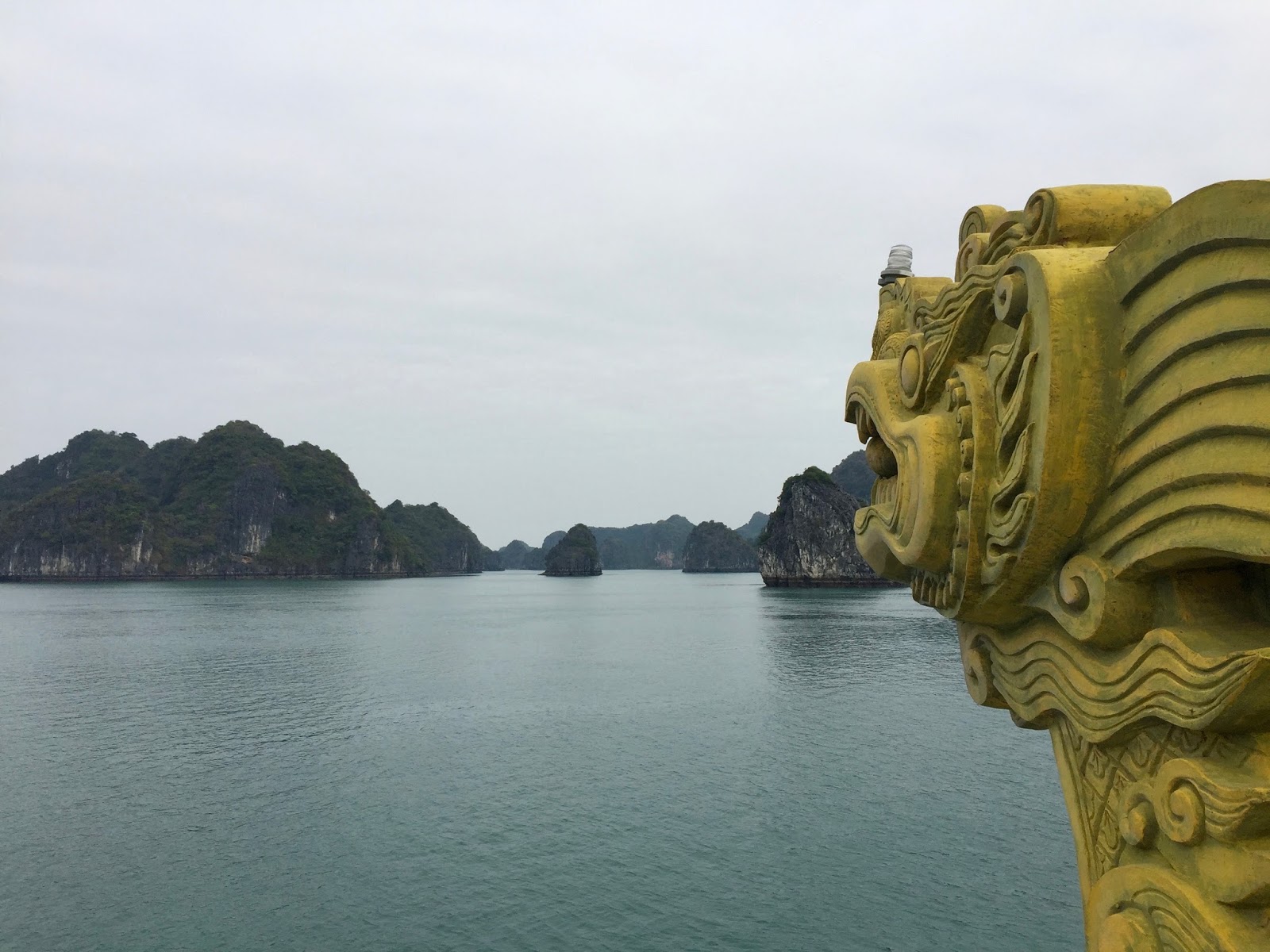
The figurehead of the Dragon Legend.


The 2 days and 1 night on the boat were an excellent getaway from city life and from the backpacker life we've been leading. We drank wine, slept in luxurious beds in beautiful cabins, and ate well prepared food in a sit-down setting. We met some great people, the most Americans we've seen in a while. And we relaxed in a setting that allows you to breathe the fresh air and take in the beauty of nature. And when we looked to entertain ourselves, a couple rounds of Jenga did the trick.

We also spent one night at a homestay in a local village called Yen Duc. It's a strange arrangement this village has. It's become a tourist stop for those coming from Ha Long Bay. The community organizes water puppet shows. So people end up coming to see the show and touring the village if they have some time. For us, we decided to stay a night in the village and learn about the locals.

Rice farming in Yen Duc Village in the countryside. 

The Yen Duc Village community is very proud. 


The first afternoon we spent with a local fruit farmer, who also had a large collection of bonsai trees. Apparently, ownership of said bonsai trees is an indication of wealth. His fence / wall around his property is abnormally tall to keep out the thieves. He share his fruit with us and just wanted to meet us and to learn where we were from. This man was so welcoming, and all without any benefit to him. We were informed that he received no money from our visit. He just wanted to be exposed to us.

We went for a bike ride around the village. There are no cars in this village. It's very easy to get around. 


Afterwards, we visited what seemed to be the tour grounds where the water puppet show was practicing. Here, we learned how to process rice with manual tools, an arduous process. We also had the opportunity to learn how locals used to fish in the ponds with bamboo baskets. The girls had a good time testing their luck in the murky waters. I was certainly amused as a photographer.


On our second day there, we were taken to another local's house. Our host was 70 years old, and her job was to make brooms out of the dried rice stalks left over from after the rice was harvested and processed. She was a delight. She was so happy to meet us and was a great teacher. She instructed us how to make a small broom. The process was tedious but you could see each step that she took with the limited supplies she had. The process is completely manual in that you wound each thread and really formed every piece of the broom from handle to bristles. The lady was engaged completely in showing us all the intricate steps to complete our brooms. It was such a fun project. Our guide told us that she is the poorest woman in the entire village. She earned only 30,000 dong ($1.15) from this visit and her brooms would fetch anywhere from $1 for the smallest to $5 for the largest. Her family was unable to help her because they were all farmers and did not make as much money either. Our heart went out to her, but there was nothing we could do to help her. So we thanked her, hugged her, and took a photo with her which made her very happy. It's sad to learn how poor and difficult life can be through first hand interaction, especially when you're on a formal tourist tour.