Showing posts with label Investment. Show all posts

Saturday, February 12, 2022

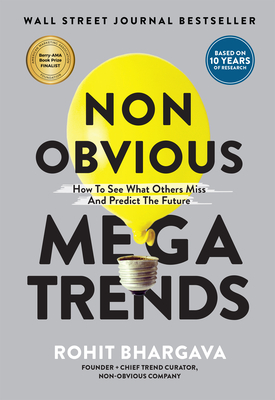
Non Obvious Megatrends: How to See What Others Miss and Predict the Future by Rohit Bhargava

When you pick up a book in a series, the biggest fear is that you won't be able to fully appreciate references that are made in the latest edition. That is definitely not the case here as the Non Obvious series is crafted in such a way that there are recaps to support the continuation of trends that weren't so obvious in the past. You get a glimpse at the genesis and evolution of ideas, the divergence in the paths from the old trend, or the support and building blocks to the current trend. The book allows you to imagine how things may play out or fizzle. 

While the collection starts with the methodology in seeking out or identifying trends, the heart of this book consists of Bhargava's current thoughts on trends that we're unconsciously following and contributing to in society. And the tail end recaps and assesses the past identified trends, whether they survived or flopped or took an alternative route and nevertheless blossomed into something else. 

I enjoyed this book for the easy read it was and the hints at what to look for in trendsetting across a variety of industries / subjects. I think this book will really hit hard for the creatives and analytics in our lives. Designers, marketers, advertisers, investors, retailers, and people interested in the possibilities of our future will find a topic to cling to and see out. 


Check it out on GoodReads. 

Buy it on Amazon. 

Wednesday, June 17, 2020

Big Data & Human Stupidity

Excerpts from today's reading from the tail end of Chapter 3 of 21 Lessons for the 21st Century, by Yuval Noah Harari


"The danger is that if we invest too much in developing AI and too little in developing human consciousness, the very sophisticated artificial intelligence of computers might only serve to empower the natural stupidity of humans."

...

"To avoid such outcomes, for every dollar and every minute we invest in improving artificial intelligence, it would be wise to invest a dollar and a minute in advancing human consciousness. Unfortunately, at present we are not doing much in the way of research into human consciousness and ways to develop it. We are researching and developing human abilities mainly according to the immediate needs of the economic and political system, rather than according to our own long-term needs as conscious beings."

...

"We are now creating tame human that produce enormous amounts of data and function as very efficient chips in a huge data-processing mechanism, but these data-cows hardly maximize human potential. Indeed, we have no idea what our full human potential is, because we know so little about the human mind. And yet we don't invest much in exploring the human mind, instead focusing on increase the speed of our internet connections and the efficiency of our Big Data algorithms. If we are not careful, we will end up with downgraded humans misusing upgraded computers to wreak havoc on themselves and the world."

...

"But just as Big Data algorithms might extinguish liberty, they might simultaneously create the most unequal societies that ever existed. All wealth and power might be concentrated in the hand of a tiny elite, while most people will suffer not from exploitation but from something far worse - irrelevance."

Big Data Knows Everything

Monday, June 15, 2020

Buffett: The Making of an American Capitalist by Roger Lowenstein

Learning about Warren Buffet and his meteoric rise as an investor over the course of a lifetime through Berkshire Hathaway, Inc. as a vehicle was so insightful. Roger Lowenstein wrote this biography in a way that keeps your interest intensely. The details of Buffet's formative years provided evidence and support that make his strategies and investments so logical and elementary. Buffet's fundamentals never left him and he's been able to adapt to the times. Despite the turmoils of the markets, economies, and politics the way Buffet kept his footing and continues to stand on the foundation of his success is proof that the basics are important and that you have to always ground yourself in discipline. Like every genius and successful person, his quirks gave him character and that made for a more colorful story. 

If you're an investor or looking to dabble in investing, this biography is certain to intrigue you. Learning about the G.O.A.T. of all investors and capitalists should be atop your to-do list.


Check it out on GoodReads

Buy it on Amazon

Thursday, October 19, 2017

Get Your Umbrellas Out Because I'm About to Brainstorm (Again)


While I'm on the topic of investments, I recently had a recollection of all the random ideas I've had in the past that never made it anywhere. For a while, I "invested" my time in developing some concepts that I hoped would make it big someday. The names needed to be short and catchy; the domain name had to be available and memorable. The product or service had to be something people would be interested in, and at the time I thought that was enough. Little did I know that the product / service also needed to be needed and solve a problem. (I know these things now because I watch Shark Tank religiously.)

Then I registered the domains, created the administrative email accounts, setup a Google Suite account, and if the idea was good enough - I recruited a small team to help, created a website, FB page, Instagram, and Twitter account. Of all the ideas that ever completely made it down that path, there were only two - my own blog and DrunkEats. But the vast majority of other thoughtful possibilities only got domain names. And even with that, the names and ideas were a stretch away from anything remotely possible.

But there is one idea that I constantly keep at the forefront of my imagination hoping I could further develop it and one day be smart enough to have others back it. I mean, I think it's good but its not unique enough. (Although the slogan we came up with is fantastic. Haha.) Anyway, a discussion about the service-oriented business idea resurfaced recently in a conversation with a friend who is currently going through his own newly created (but certainly thought about at length) brand development.


As I described to him the concept behind the name and could-be business idea, he chimed in with enthusiasm, even adding fuel to the gently stoked campfire burning in my mind by contributing some ideas and thoughts about it. We talked about blogging, branding, marketing, and direction. And at the end of the phone call, I told myself that I'd have to jumpstart the idea again with the team I previously enlisted many years ago when it all started. Of course, I'd want to involve my friend somehow because the more, the merrier but also the better the ideas become with more people to help it along. (396)


Wednesday, October 18, 2017

My Investment Compass


Yesterday I spent most of my day tinkering with Excel and putting together tables. My analysis was for some investments I plan to make in the near future. It was a reminder of how analytical I can get sometimes. I started out with ABC up and down the X axis, and XYZ on the Y axis and populated the cells with various formulas. Then I would rearrange the line items or add / delete lines all to get the right amount of detail.

In the world of corporate tax (my profession), it's rare that we have to put together a table from scratch. Most of the time, the data is already provided to us and it requires manipulation. Often times it's as easy as performing a VLOOKUP or HLOOKUP or simply using a Pivot Table. But there's just so much information to analyze. The trick is to know what you need for a narrow down the dataset to those categories.

The data I came up with yesterday was based on reading and research I did about various investment products which I plan to place bets on. For me, my interests are currently in:

  • Blockchain technology
  • Cryptocurrency
  • eSports
  • Environment
  • Renewable Resources / Alternative Energy
The potential for each of the above is sky high. I think we're going to see Blockchain become the accounting of the future. Plenty of businesses are currently analyzing how to implement and make use of the technology. From the success and safety of the Blockchain, cryptocurrency was developed potentially to make financial exchanges easier, non-centrally governed, and safer than transactions with intermediaries. It is yet another factor that will shrink the world and create a common denominator to create business across borders. Imagine being able to pay for your meal in a foreign country safely without having to exchange currency or use a credit card and be subject to foreign transaction fees with just the click of a button on your mobile phone. It's potentially that easy. 

Then there's eSports, and if you've read my previous posts you already know what I think. It's sports digitized and the market is only growing. I can only see an upside financially. The downside is going to be getting your kids outside for fresh air to play like the old days of activity and exercise. I'm sure the world will find some health detriments, and we should be sure to combat them and set limits. But the trend is upward for eSports. And like anything that requires moderation, it will be a matter of parental guidance and reasonableness that helps mitigate any health concerns. 

The environment and renewable energy also go hand in hand similar to Blockchain and Cryptocurrency. It's easy, the bet is that renewable and alternative energy sources will improve the environment that we live. And those who create a greener lifestyle should and will benefit in more ways than just financial - health-wise too. Solar energy is really making a statement these days. The tech has been around for years but Tesla and other solar manufacturers are really making it easier and cheaper to be environmentally friendly. Wind is also rising but less publicly. The new turbines on and offshore will have been providing electricity for a while now but drawing much less attention. Similarly, hydroelectric energy has also been around for a while but with few water sources to plug up with dams, it too doesn't get the recognition it deserves for as long as it has already served us. And the remaining alternatives include biomass, geothermal, and tidal have yet to really make a profound impact but again, the potential is great. 


I suppose over these past few months of unemployment, the experiences I've lived through, the reading I've done and the interests I've developed have helped me realize what my future holds. I know better who I want to be and how I want to carry out that lifestyle. For now, the next investments I will make are just a stepping stone for the future I want to build. And like the past few months, I'm sure these investments will be rocky at time but the long term results should be upward trending. (700)

Tuesday, October 17, 2017

From A Gamer's Perspective


My cousin's son (first cousin once removed) is my nephew for all intents and purposes.  He is an avid gamer but now a college student (and school comes first, maybe). Ever since I can remember, he's been inseparable from his video game consoles, whether it was his Nintendo GameCube, DS, Wii, or now that's he's older, his computer.

With my curiosity for eSports growing, I thought it a good idea to interview him to know what it's like as a player in the game and to analyze it like an investor to a potential investment.

Here's the transcript:

J: What kinds of games do you play?
AC: MMORPG, MOBA, Open World, First-Person Shooters, 2D Side Scrollers
Analysis: A variety of games and situations allow a single person to play with / against numerous multi-level players. Check out these stats. 

J: What system / console do you use?
AC: PC most often, Wii
Analysis: With speedy internet and an overwhelming majority of households having a computer, the basic hardware is already in place for gamers and future gamers. 

J: How often and how long do you play for?
AC: At least 8 hours a week on average
Analysis: That's practically 1 workday per week, and that's as a college student. Professionals must play 5-6 times more than that. That's time invested to learn and improve. 

J: Do you have a team that you always play with?
AC: No, I do follow teams though primarily in League Of Legends and the team name is Team SoloMid
Analysis: This team is branded, has a track record of winning, and is publicly known in the gaming world and on social media. They have all the essentials to make money. 

J: Is the gaming community around you large?
AC: Not around at my college but the community within the games are massive ranging from hundreds of thousands to millions of players.
Analysis: He's a college kid in a small Texas town. I'm not surprised. But the value in this response is that gaming is a world-wide phenomenon that draws millions of people. How's that for market size? 

J: What games do you play?
AC: League of Legends, Counter-Strike Global Offensive, Overwatch, Playerunknown Battlegrounds, Starcraft II, Maplestory, Osu, Art of War: Red Tides, Guitar Hero III, Super Smash Bros. Melee, The Forest
Analysis: The variety of games available for play are many and varied which means that there are few limits to their markets. Males and females from ages 18-38 with a computer and some money to buy games to have fun is their target. It doesn't get any broader than that...unless you don't like to have fun?

J: What skill level are you?
AC: In League of Legends I was top .8% in the world; Maplestory I was once Ranked #1 in the world; Counter-Strike I'm DMG (which basically means I'm around the top 15%). All the other games are just for fun or there is no real ranking to determine my skill.
Analysis: We have an avid, intelligent, adaptively skilled gamer here. If he wasn't pursuing an education, he definitely would have a future in eSports. But don't tell his mom I said that. She'll kill me. 

J: How important are reaction times and ability to learn levels?
AC: In the games that I played competitively reaction times were crucial especially in Counter-Strike Global Offense. A lot of the games require in-depth game knowledge, which entails being able to predict your opponent and adapt to different situations due to every game (match) being different. Learning the games were relatively easy but mastering it and being able to apply different sets of skills is almost impossible and not even the best of players are perfect at the game.
Analysis: Gaming is a skill, like being able to make handicrafts or use MS Excel or recite the law, it requires time, practice, patience, and concentration. Last I heard, skilled workers were fairly well paid. 

J: Do you participate in tournaments?
AC: I used to
Analysis: Good. You should be studying while you're in school. Make sure you tell his mom I said that. 

J: How large are they? How much do they cost to join? What is a typical amount you might win?
AC: Some consisted of 20 players others consisted of 100+, it depended on what type of tournament. Most tournaments were $5 to enter per player (team of 5 in regards to League of Legends and Counter-Strike Global Offense) and some made us pay $15 per person. Normally we would win $100 or more.
Analysis: His response seems typical for smaller tournaments, but I'm sure that the bigger tournaments that have $1M prize money require quite a bit more to buy-in.

J: Do you find  that you need to practice?
AC: Yes, if you did not practice you'd be left behind due to the game always changing (patches, updates, etc.) and people are always finding out different builds which changes the META (META = the things that worked in game, strategies, champions that fit those strategies)
Analysis: Practice makes...winning. Because as he said, it's nearly impossible to be perfect. I suppose relative to your competition you could be perfect, but it's adaptive gaming that wins. 

J: Did you build your own computer?
AC: Yes with my friend and my dad
Analysis: Parents getting involved is not uncommon. According to a study done by the ESA, 67% of parents play video games with their kids once a week. When you have support and involvement, there are less barriers to entry. Meaning, parents will shell out the money for their kids games. And that is a source of income for the gaming industry. 

J: Do you use specific hardware / software because of quality?
AC: Yes, some games won't run if your computer specs. aren't up to par with the games minimum standard. Some games are graphic intensive (not League of Legends or Counter-Strike Global Offensive) so if your computer can't hold up your FPS (frames per second) would be very low and it would cause an inability to react which in turn makes you a bad players.
Analysis: The better you become at gaming, the more likely you are to want to upgrade your gear. So the components industries are also making gains. Keep an eye out on the software and hardware companies stock price as the gaming industry grows. 

J: Does your school have an eSports team for gaming? If so, is it sponsored?
AC: No
Analysis: But more and more schools do. As the eSports industry grows in the adult world (NBA, NFL, MLB, MLS, etc.) so will the collegiate and high school markets. Just take football as an example - there are the pee-wees, pop warner, freshman, JV, Varsity, Collegiate, Semi-Pro, and Professional levels. 


This interview was pretty insightful. I learned a lot about my nephew and the gamers' perspective. But I was also able to do a little analysis as an investor. eSports is going to grow and now is the time to invest. It's now time to do a little more digging on where to place these bets. (1188)

Monday, October 16, 2017

eSports Is On The Rise


Last night I started to read about something new to me but not new in general. eSports. Kids and many of today's adults play video games. (I say "today's adults" because they are the generation that pioneered gaming systems 30-40 years ago.) And in the recent years, the video-gaming industry has turned what was once friendly competition into a money-making, competitive, league-forming battlefield.

Players are now considered "professional" depending on their "skill" level at beating their enemies or completing tasks / levels. And there are many, many players out there. So many, in fact, that tournaments are organized and bring hundreds if not thousands of players. But most significantly, the events bring spectators, enthusiasts, amateurs, and others to watch the fast-paced motion graphics on big screens in arena-sized locations. We're talking about millions of people involved here. eSports are taking on a life very similar to real life physical sports (NFL, NBA, MLB, NHL, MLS, etc.).

And the prize money is not insignificant. This is a link to the Top 100 games with the most prize money awarded over time. Clearly, there's plenty of cash to motivate players to improve their gaming abilities to be good enough to compete.

I suppose it's no real surprise that the money is there. I mean simple investment strategy tells us that you have to put money in to get money out. That is, you have to buy the equipment (games, consoles, controllers, graphics cards, microphones, headsets, etc.) to put in the time and practice, and once you've achieved that certain player level, you might reap the rewards monetarily. How good you are determines your Return On Investment (ROI).

But now that there are established tournaments all over the world and the frequency with which they happen is often, the idea of creating leagues and teams for profit must have been tugging at the purse-strings of investment related mindsets. It was just a matter of figuring out how to monetize the industry. And now it's been done.

The industry has been growing for the past couple of years already. Expectations are for the size and wealth of the players, investors, gaming designers, software companies, hardware manufacturers, and all the other peripheral positions is growing exponentially. Actual franchise teams are investing in their eSports teams. Even celebrities are getting in on the action. And it clearly makes sense. The investment is relatively cheap, the target market is growing (in population), and the returns are proven.


The target market grows in so many ways too. You have the gamers and spectators on the high side of the age range who continue to age (obviously) but with that comes more disposable income. And since they're already locked into the mindset, it's natural to continue to support something they've "grown" with. On the other side of the spectrum are the kids who are entering the gaming age. We know that there are millions of kids born each each. That just means the chances of developing a fan, a gamer, or an investor in the future is pretty good.

And technology is constantly improving. We're getting better computers, improved graphics, and faster internet everyday. The world is becoming smaller, faster, and more capable all the time. This all makes the gaming industry that much more capable of supporting the inevitable gold-rush-like boom that will continue for the next few years.

I'm very interested to see where this goes, both in the short term and the long term. As one of today's adults, it will be one of those things that we'll look back on and say, "I was around and conscious of it all when this movement started." And my hope is that I too can get in on the action in the near future and make a future for myself with that. Anyone want to take a risk too? (641)


Friday, September 22, 2017

8 Things That I Am Learning About


Lately, I've been reading about, paying attention to, and/or doing a number of things to keep me up to date on current events, trends, quality of life, the environment, and other personal interests. Here are some: 


  1. Reading. It is FUN and Mental and FUNDAMENTAL.
  2. Blockchain. It is the future of the Internet, Data Management, Banking, and Travel among other things.
  3. Cryptocurrency. Although I'm not convinced it is the future of money, it's certainly a game changer and something to pay attention to.
  4. Credit. Because WTF Equifax?! Make sure to sign the petition to make credit freezing FREE for all, not a free-for-all.
  5. Investing. Whether it be about equities, real estate, or time. Here's a new platform that is popularizing trading for the new generation.
  6. Climate Change. Because WE SHOULD HAVE Paid More Attention Before, But It's NOT TOO LATE Now - Make An IMPACT
  7. Travel. You cannot learn to swim by reading a book; you need to throw yourself into the sea or into a swimming pool for that. The same happens if you want to practice yoga; reading books about yoga is useless to achieve a real yoga experience. If you want to know the world you must travel the world." -Jorge Sanchez

Follow me on Twitter to keep up with my daily musings. 

Tuesday, June 13, 2017

Transition Tuesday: Changes to Make After Spending Life Overseas

Life's a beach...at least it should be. 

When you have a lot of time on your hands it's easy to make lists. This one is for improvement. I want to improve the way I live my life, and this is how I will do that.

  • Read more books. There's plenty of information, perspectives, insights, and opinions out there to learn from. And books are the platform. Despite the movement to e-readers and text available online, I still prefer the hardcover/paperback versions of books.
  • Maintain weight. You've read this from me before. But this time it's different. At 291lbs before we left, I struggled. My goal is to weigh-in at under 250lbs going forward. My best was 109kg (238lbs) while we were in South Africa. But I don't know how feasible that is to maintain. But I am pretty sure I can swing under 250lbs from now on. How will I do that?
    • Coffee - I started to drink coffee because it will boost my metabolism and help me move my bowels better. 
    • Drink plenty of water. While we were abroad, I drank something like 3-4 liters of water per day. We were doing a lot of walking and sweating in the heat so I needed it. 
    • Eat fruits and anything with natural sugars in the mornings to give them a full day to digest, break down, and burn off. 
    • Keep the carbs low unless I know I will need the energy for an intense workout or other strenuous exercise (hiking, rowing, climbing, etc.). Also, eating them for lunch will give them some time to digest. 
    • Increase my protein intake. This should include more fish, poultry, and lean meats. Finding and consuming alternative protein sources (like soy, nuts, yogurt and other dairy, etc.) is key to keeping my diet interesting and varied. 
    • Eat more vegetables. I was not a fan so much of eating veggies. I mean, I would do it but not often. Our time abroad has given me such a better appreciation for clean, organic, vegetables. In so many places around the world vegetables are the main dish. Meats and other foods are a treat.
      • We recently started our own little organic herb garden. We will have a variety of mints, parsley, and cilantro/coriander. Will keep you posted on how our garden grows. 
    • Try to eat more organic, non-processed food. It's hard. And it's expensive. But to the extent possible, we will make it happen. 
    • Add chili peppers to my food to make it spicy! This will keep my food interesting and may also help with metabolism and limiting the amount of intake.
    • Workout at the gym 3-4 times per week, even if it means going to work late or leaving work early. Because at the very heart of it all, I always blamed the lack of time to go to the gym on my work schedule. But like my boss has always said, it's not worth dying for. So I'm going to the gym, so I won't die at work.
  • Reduce daily stress. My former manager always told me that we have to live one day at a time, not to let the challenges of work or life make you crazy. I always listened to him and tried to not let things bother me, but it took this trip to really change my mind. One day at a time, one thing at a time.
  • Invest. Time, money, effort. We did a lot of thinking, and our conclusion was that we need to establish ways to make our own lives better and build a foundation for our future child(ren). So we're going to invest in property. A timeline was made and the hope is to stick to it as closely as possible to maximize the future benefit. We contemplated if it should be foreign property or domestic, and we narrowed it down to select cities. Now it's just a matter of executing.
  • Clean up. There are plenty of items, tasks, and thoughts that are unnecessary in our lives. The goal is to trim off what we don't need. If it occupies space and is never used, discard it. If the to-do can be lived without, then forego it. If the idea or thought causes stress, then try to turn it into a positive and learn from it. There are other mountains to climb and conquer. The goal is to see the top and look down on what has been accomplished, and how can that be fun if you're bogged down with the useless?