Showing posts with label Climate Change. Show all posts

Saturday, February 26, 2022

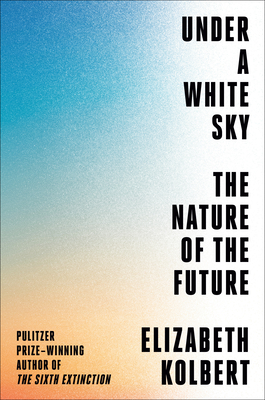
Under a White Sky: The Nature of the Future by Elizabeth Kolbert

I read the first 3 chapters and thought to myself, "This should be a Netflix series." And so I sent Elizabeth Kolbert a message on Twitter, and she responded! Exciting! 

That's besides the point, which is that this book is one the examines a small handful of very interesting topics, and Kolbert intertwines their relevance back to the impacts of climate change and man's defiance of nature. Take a singular natural occurrence, understand it's evolution over time - how's it changed / adapted / grown / shrunk / morphed - and you'll find that we've unknowingly and unconsciously altered that instance's course of existence. And then once we've learned that we've altered it, we try to reverse engineer the process to revert it back to old - what we think it should have been. 

As humans, we've become skilled at deviating a natural path, trying to course-correct it, but impacting other natural processes simultaneously. All this to say that while we think we can control the uncontrollable, the only thing we're really doing is harming ourselves in the process. 

Kolbert makes it so easy to visualize and comprehend that these seemingly inconsequential issues are just a sampling of the global damage occurring on a daily basis, some with a butterfly effect. 


Check it out on GoodReads. 

Buy it on Amazon. 


Thursday, December 31, 2020

The Uninhabitable Earth: Life After Warming by David Wallace-Wells

The dangers of climate change are coming sooner than you think. If you're reading this post right now, you'll probably still be alive when some of the worst imaginable things could come to fruition. Come on, you've already felt the affects. Don't be naive. Just accept the fact that it's coming. But do your best to contribute to mitigating the factors.

Climate change will impact every aspect of our lives. It will distort the pictures in our minds of a world that once was, and stories told to our children will seem fairy-tale-like. 

This book, The Uninhabitable Earth: Life After Warming, is a flavor for what's to come. It might seem extreme and the numbers may come off as hyperbole, but make no mistake, if we continue on the path we are on, life could be a living nightmare. 


Check it out on GoodReads.

Buy it on Amazon.

Thursday, December 10, 2020

This Changes Everything: Capitalism vs. The Climate by Naomi Klein

 Comprehensive. 

Through 2014, this is certainly the word I'd use to describe the way this book was written. This Changes Everything: Capitalism vs. The Climate examines seemingly almost every aspect of climate change. Naomi Klein's research is extensive and global. The causes, effects, potential, the conflicts, possible solutions, the ideas and failure, the who / what / where / when / why if everything that climate change touches is addressed in her writing. She even gets personal, and that's the most heart-wrenching part. Because it's easy to see climate change as an existential crisis, it's easy to just set it aside in your everyday life. But once it hits you, once you're affected and cannot avoid the direct impact and parallels, your personal life will never be the same. 

I loved this book for how it addressed everything that I ever thought about and more about climate change. The exposure to different lines of thought and possible outcomes was insightful and sometimes anger-inducing. 

And after reading it all, if someone remains unconvinced that climate change is real and that actions need to be taken, then that person is unfortunately delusional. For me, this was further proof and knowledge about the goings-on of climate change. And I wonder what Klein would add to this since 2014. Obviously many things have changed, and more change is coming in 2021 with a brighter outlooks. I'm anxious to see how climate change and our reactions will guide our future. 


Check it out on GoodReads.

Buy it on Amazon. 


Tuesday, September 8, 2020

The Halfway Mark: What have we accomplished in 11 years?

Scientific American - November 2009

I'd be really interested to read an update of this article and see where we stand today, as of 2020, which was supposed to be a halfway mark for the 2030 potential. It all seemed to be very doable, but have the obstacles that we encountered in the past 11 years significantly slowed the plan for a sustainable future? For sure we've made significant progress, but are we too late in preventing sea level rise, droughts, and extinction? How much have we accomplished in 11 years? How much still remains? Curious.

Monday, September 7, 2020

Another Reason Why Bhutan's Beauty Remains In Tact


Bhutan is the World's First Carbon-Negative Country


And another reason why Bhutan will always remain in our hearts...

Read about our time well spent in Bhutan, here.


Paro Taktsang (aka Tiger's Nest) - Paro Valley, Paro District, Bhutan - circa April 2017

With our friend's mom - She is a host, local guide, and loving mother. As you can imagine, we were treated like family. 

Our new friends - Tshewang & Tshering and Auntie's dog.


Saturday, September 5, 2020

"Wisdom is like rainwater - both gather in the low places."

On Climate Change: 

"For a couple of hundred years we have been telling ourselves that we can dig the midnight black remains of other life forms out of the bowels of the earth, burn them in massive quantities, and that the airborne particles and gases released into the atmosphere - because we can't see them - will have no effect whatsoever. Or if they do, we humans, brilliant as we are, will just invent our way out of whatever mess we have made.

And we tell ourselves all kinds of similarly implausible no-consequence stories all the time, about how we can ravage the world and suffer no adverse effects. Indeed we are always surprised when it works out otherwise. We extract and do not replenish and wonder why the fish have disappeared and the soil requires ever more "inputs" (like phosphate) to stay fertile. We occupy countries and arm their militias and then wonder why they hate us. We drive down wages, ship jobs overseas, destroy worker protections, hollow out local economies, then wonder why people can't afford to shop as much as they used to. We offer those failed shoppers subprime mortgages instead of steady jobs and then wonder why no one foresaw that a system built on bad debts would collapse. 

At every stage our actions are marked by a lack of respect for the power we are unleashing - a certainty, or at least a hope, that the nature we have turned to garbage, and the people we have treated like garbage, will not come back to haunt us."

This Changes Everything: Capitalism vs. The Climate by Naomi Klein


On Joy:

"The Dalai Lama was describing the Buddhist concept of mudita, which is often translated as "sympathetic joy" and described as the antidote to envy. Mudita is so important in Buddhism that it is considered one of the Four Immeasurables, qualities we can cultivate infinitely. The other three are loving-kindness, compassion, and equanimity. "

"Mudita recognizes that life is not a zero-sum game, that there is not just one slice of cake in which someone else's taking more means we get less. Mudita sees joy at limitless."

The Book of Joy: Lasting Happiness in a Changing World by Dalai Lama XIV, Desmond Tutu, Douglas Carlton Abrams 


On Indebtedness:

"To be indebted is to fixate on the future. I tense up after good fortune has landed on my lap like a bag of tiny excitable lapdogs. But whose are these? Not mine, surely! I treat good mortune not as a gift but a loan that I will have to pay back in weekly installments of bad luck. I bet I'm like this because I was raised wrong - browbeaten to performs compulsory gratitude. Thank you for sacrificing your life for me! In return, I will sacrifice my life for you!

I have rebelled against all that. As a result, I have developed the worst human trains: I am ungrateful. This book too is ungrateful. In my defense, a writer who feeling indebted often writes ingratiating stories. Indebted, that is, to this country - to whom I, on the other hand, will always be ungrateful."

Minor Feelings: An Asian American Reckoning by Cathy Park Hong


On Weakness:

"Now, we should also realize that the recognition of our own limitations and weaknesses can be very positive. This can be wisdom. If you realize that you are inadequate in some way, then you develop effort. If you think, everything is fine and I'm okay just as I am, then you will not try to develop further. There is a Tibetan saying that wisdom is like rainwater - both gather in the low places. There is another saying that when the spring bloom comes, where does it start? Does it start on the hilltops or down in the valleys first? Growth begin first in the low places. So similarly if you remain humble, then there is the possibility to keep learning. So I often tell people that although I'm eighty years old, I still consider myself a student."

- Dalai Lama XIV


On Humility: 

"The word humility actually comes from the Latin word for Earth or soil, humus... Humility literally bring us back down to Earth, sometimes with a thud."

"Humor like humility, comes from the same root word for humanity: humus. The lowly and sustaining earth is the source for all three words. Is it any surprise that we have to have a sense of humility to be able to laugh at ourselves and that to laugh at ourselves reminds us of our shared humanity?"

- Douglas Carlton Abrams 

Climate change has never received the crisis treatment from our leaders


"Climate change has never received the crisis treatment from our leaders, despite the fact that it carries the risk of destroying lives on a vastly greater scale than collapsed banks or collapsed buildings."

"Clearly, what gets declared a crisis is an expression of power and priorities as much as hard fact. But we need not be spectators in all this: politicians aren't the only ones with the power to declare a crisis. Mass movements of regular people can declare one too."

"Slavery wasn't a crisis for British and American elites until abolitionism turned it into one. Racial discrimination wasn't a crisis until the civil rights movement turned it into one. Sex discrimination wasn't a crisis until feminism turned it into one. Apartheid wasn't a crisis until the anti-apartheid movement turned it into one."

Sunday, August 30, 2020

Solar Energy: My Financial Logic is at War With My Conscience

Tesla Solar Panels


Over the past few years, solar energy has interested me to the point where I asked that our house be built to enhance the support for future solar panels on the roof. My personal financial investments have also revolved around renewable energy. And so I've recently looked into having solar panels installed on our home. In my opinion, it's not yet inexpensive from a financial standpoint. 

But from the perspective of climate change and the health of our environment, it's probably invaluable at this point. 

Here's the high level overview and some of my thoughts: 

  • One of the first things that people interested in solar look into is the Investment Tax Credit (ITC). Despite the fact that solar hasn't been so widely adopted yet, the credit seems to be already phasing out. The credit comes as a tax benefit and is computed based on the initial cost of the system. You get the full credit in year one. As you can see, residential customers have less than 3 years to get any kind of credit for adopting solar. I hope that there is a renewal of the incentives. 
    • 2016 – 2019: The tax credit remains at 30 percent of the cost of the system.
    • 2020: Owners of new residential and commercial solar can deduct 26 percent of the cost of the system from their taxes.
    • 2021: Owners of new residential and commercial solar can deduct 22 percent of the cost of the system from their taxes.
    • 2022 onwards: Owners of new commercial solar energy systems can deduct 10 percent of the cost of the system from their taxes. There is no federal credit for residential solar energy systems.

  • Solar panels have a life of somewhere between 20-25 years. But they have practically no maintenance, other than maybe having to spray them down with water to remove any bird droppings. 

  • The ability to capture enough sunlight depends on the orientation of your house, how much sun you receive, whether or not you have trees or adjacent buildings creating shade, the slope of your roof, and the surface area of roof you have to add panels to. 


    Southward facing home with 46 solar panels
     
    Heat map - yellow = most exposure = most efficient; dark orange = least exposure = lease efficient


  • Some solar companies can only build you a system that does not exceed 10% of your power utilization. They use the previous year's energy bill and consumption in kilowatt hours as a guide. 
    • I take issue with this because the older your home gets, the less efficient it is. Additionally, if you had problems with energy consumption in the past year, your data may not be as accurate. A system built today may not be appropriate for your usage in 5 / 10 / 15 years. 

  • Unless you live on a farm or out in the middle of no where, you have to remain connected to the energy grid. A battery is really only good for storing energy in case the power goes out. I learned that if there is a power outage, because you are still connected to the utility and the solar power feeds the utility lines automatically, if there is a power outage, the solar system shuts down automatically. So there's not really an option to be living a battery-powered life. In any event, a single battery costs about $9-15k. So tack that on to the cost of your system. And likely, you will need more than 1 battery if your home exceeds a certain size. 

  • The cost of the system itself depends on the amount of energy you will need to create and the amount of space that you have to lay out solar panels to create and store that energy. In general, the bigger the house, the more energy consumed, the more panel you will need. 
In our case, we averaged somewhere in the range of 1500-2000 kilowatt hours of consumption over the past year which ranged in cost from $175 to $225 per month. The solar panels necessary to run our home at this rate would cost us about $36,000 for the panels alone, and that's paying it up front (not a loan) and getting the 26% federal tax credit (which comes when you file your tax return). So the cost of cash out the door on day one is really +/- $48,000 and then you have to wait to get your credit when you file your tax return. If I added a single battery, the cost would be an additional $12,000; two batteries would cost $19,000 (both before tax credit). 

There are other options that the solar companies offer. The one that draws the most attention is the $0 due at signing / no cost today. Essentially what happens is you can finance the cost of your system over 10 or 20 years. The interest they charge is 2.99% for 10 or 4.99% for 20 years. And you, instead, have a monthly payment to make to the solar company rather than the utility. So you end up paying more, obviously. The $36,000 system will cost roughly $44,000 by the time you're done paying it off.

My first issue with this is if I wanted to finance the cost of my solar panels, the better option would be to take out a home equity loan or borrow against my home. With interest rates so low these days, I'd get a better deal that way. 

My second issue with financing is if you choose the longer option at 20 years to avail of a lower monthly payment, by the time you're done paying for the system you've reached nearly the end of the life of the panels. By that time, you'll have to replace panels or worse yet replace the entire system. Have you really saved any money then? Or are you just breaking even? 

Also note: solar panels are not a home improvement. They are considered tangible personal property and not a fixture of the house. That being said, they do not improve the value (financially) of your home. In fact, if you wanted to take the solar panels with you to your next home, in theory, you could. But solar companies still advertise that having a solar system will increase the value of your home. I suppose it could, if the buyer of your home was willing to purchase the panels from you, but they could easily say they love the house but not the panels and have you remove them before you sell. In which case, you've got to shell out the money to have them taken down, and then there's no guarantee that they'll fit on the new home you're moving into. 

My problem now is one that's moral and ecological. While I know that becoming self-sufficient from an energy perspective will help the environment and that installing these panels would be doing our part in "saving" the world, my financial logic is at war with my conscience. I cannot justify the cost mathematically. The cost vs. (financial) benefit is about even. But the (financial) cost vs. (climate change) benefit is heavily in favor of adopting a solar energy system. 

Have any of you gone down this decision path? If so, please feel free to share your insights. And if I've gotten anything wrong up there, please help me understand so that I can correct my thinking. Many thanks! 

Thursday, August 27, 2020

Your Mother


You remember what happens when your mom tells you to do something and you go on lollygagging along and forget to do that one thing...

You get your ass beat.

Don't forget who your mother is and make sure you listen and act accordingly.

Wednesday, August 26, 2020

OPINION: COVID-19 the Climate Changer

While I was reading a book published in 2014 about climate change, it re-occurred to me that COVID-19 is mother nature's way of combating climate change on her own. This isn't the first time I've thought this.

There's a section that describes the tug of war between capitalism and the economy versus the efforts of climate change experts and environmentalists. My understanding is that the ideals of each side are contrary to each other, making their efforts inversely related. 

With COVID-19, although it's a health issue, the impacts to capitalism and the environment are both positive, actually. How so? 

In terms of capitalism, the stock market (not that it's a great indicator or all encompassing) is booming. There is significant unemployment currently, but I think it's a stepping stone towards future sustainable growth and development. The housing markets affected by low interest rates are great for buyers and sellers can profit from the demand. Construction continues to build and improve in growing areas. And despite small business failures due to health restrictions, I believe they will rebound because those who suffer and survive will learn and grow. 

In terms of the environment, the reduction of daily commutes, daily flights, and the constant movement of floating waste factories has all been minimized. Pollution on a grand scale has been reduced significantly. More people are working in their yards due to travel restrictions and boredom. Less people are driving daily. More people are growing their gardens for the same reasons. There's more time to tend to these basic things now that the economy is on temporary hold. 

In a way, COVID-19 is a climate changer in itself. It's changing the climate of capitalism. And it's helping to change the actual climate of the world. Looking at the positives rather than the negatives, COVID has been helpful. Some will say that it's at the expense of others' well-being and health, and I agree. It's tragic and sad. And I feel terrible for those who are suffering and being challenged physically and mentally. Everyday we hear about these things and it doesn't change the somber mood, but hey, I'm trying to look at it from a different angle. 

Thursday, May 3, 2018

Where Did Spring Go?


I used to have really bad Spring-time allergies. Watery, itchy, swollen eyes. Stuffy / runny nose. Constant sneezing. If you’ve got allergies, you know what I’m talking about.

Strangely, I have not suffered from the itchy eyes recently. Although, I have been sneezing a good amount and blowing my nose constantly. So I have some symptoms of the pollen-driven reactions, but not all of those I’m used to experiencing.

I narrowed it down to 4 possible reasons.
  1. After LASIK eye surgery, the laser must have burned off the ability to sense irritation in my eyes. 
  2. I have spent so much time outdoors and being exposed to different environments that my body, eyes specifically, has developed an immunity to the irritants. 

  3. My mostly organic diet has improved my resistance to pollen allergies. Specifically, my consistent daily intake of carrots has strengthened my eyes in more ways than one. 
  4. Climate change is real. Spring no longer exists or has been severely curtailed. Pollen is not as abundant in the environment, leading to less plant life that would normally absorb the CO2, in effect allowing greenhouse gases to grow in the atmosphere, leading to global warming. 

Or maybe all of the above.

What do you think?


Monday, April 23, 2018

Before the Flood

What if there were other planets that were once like ours? Abundant, full of life, and intelligence. What if they lived the same life path as we have for thousands of years? What if they too destroyed their own being through poor politics, greed, and ill paid attention to climate change and global warming? Maybe they wouldn’t be the deserted, barren, lifeless planets they are currently with only traces of a life once lived before the gases choked the atmosphere and caused a chain of events that might have been stopped if it weren’t for politics. Maybe Earth’s future is in the stars…

These thoughts came after I watched a documentary produced by Leonardo DiCaprio called “Before The Flood” on Netflix. It was another documentary on Climate Change and the harmful effects. I think this was just as good as "The Inconvenient Truth" and it’s sequel.

Here, check out the trailer:

Thursday, December 14, 2017

That's One Small Step Climate Change, and One Giant Leap For ME And Our HOA


It's a small step in the right direction, but every little bit counts.

Today I was informed by a board member of the Home Owners Association (HOA) that the board voted to have a new dumpster situated in our complex to recycle plastics!  To be accurate, they will be replacing the cardboard dumpster with a cardboard/plastics dumpster, presumably with a divider to segregate the two recyclables.

I'm pleased to hear this because I requested that this initiative be taken back in September. It took a couple of follow-up emails, but I'm glad that we're moving forward on the issue of recycling and doing our part to save the environment.

Thursday, October 26, 2017

Step Master & The Environment

We've been home from our travels abroad for nearly 5 months now. Since then, I've gone to the gym on average 4 times per week. The gym is approximately 1.1 miles away. That being said, I've walked just about 176 miles in the past 20 weeks. And that's just going to the gym. If I include all my other walks, randomly around the neighborhood, to/from the park and basketball court, to/from the grocery store, and to/from my cousin's house then I've most likely broken 200 miles. I only drove to the gym once because it was raining.

How does that compare to someone who walks 10,000 steps each day? Well, according to The Walking Site, there are on average 2,000 steps in a mile. So 10,000 would be 5 miles. If you walked 5 miles per day, 5 days a week, then over the past 5 months you should have accumulated 500 miles or 1,000,000 steps!

Keep in mind, the 200 miles I've racked up is just from walking alone. That doesn't include the running on the treadmill, climbing the stair master, cycling, and other exercises that count towards that 10,000 steps per day goal. Nor does it include any other strenuous activity like playing basketball, biking within an 8 mile radius, or other sports.

The 200 miles of simply walking to the gym and other nearby errands / places is 40% of the pie already. Do I achieve the other 60% from all the other activities combined? I have to believe that I do.


In addition to the health benefits that I'm reaping, I've saved money on gas, wear and tear on our car, and most importantly reduced my carbon footprint and emissions. The carbon footprint calculator estimated that 0.07 metric tons of carbon would have been emitted had I driven the 200 miles instead of walked. It might be small, but every little bit of help the environment can get is worth it. And it only cost me 30 minutes per day.

How much walking have you done for your health and the environment? (346)


(Flashback to that time we made it to Mt. Everest Base Camp)
(Time: 14 days | Max Altitude: 17,602ft / 5365m after 9 days | O2: 50% less than sea level | 80 miles round-trip)

Wednesday, October 25, 2017

A Poll, Avocados, & Pop Culture


A little over a week ago, I took a poll about my recent avocado spending habits. In an effort to become more engaged with my readers and Twitter audience, I left the survey open for 7 days and got a few responses. Maybe what I should have done is embedded the poll here on my blog as well. I'll do that going forward. In any case, the results are fun and interesting. I'm happy that 67% of poll participants support my cause. I agree with them. I have to say that I enjoy eating guac. For anyone who answered in the negative, why?


I've been buying quite a bit of avocados and specifically guacamole to get my Omega-3 fatty acids into my diet, amongst other vitamins and minerals. Surprisingly, the local grocery stores make it fresh nearly everyday. It's about $5-6 give or take for about nearly 1 lb. of the mix of avocados, cilantro, lime, tomato, onion, garlic, salt and pepper. Stop and Shop makes it a little on the spicy side, which I like. If I so happen to be at Costco, I'll buy one of the guacamoles they carry too because it's individually packed for 100 calorie intervals. Either way, it's a good deal financially (for now - but it should and will get better) and healthwise.

I wonder why avocados took so long to become so popular in food culture? Maybe it's the high price point for a single piece of the buttery fruit. Hopefully, we can somehow manage to tackle the supply issue to be a closer match to the demand to help prices (on average $2 for a single Haas avocado) come down a bit.

Clearly, it's been widely eaten in Mexico for hundreds, if not thousands, of years. But why has the rise to stardom of this versatile fruit taken so long? Why do I feel as if Millennials and Generation Z started this trend? Actually, I don't think this is going to just be a trend. Similar to alternative and renewable energy, this fruit is now and will continue to be a strong player in the food world. With all the benefits avocados have to offer, it's tough to see it as just a trend. That is, unless global warming and climate change affect the production. (413)

One of my favorite brekkies in Australia - avocado toast or avo toast for short.


Friday, October 20, 2017

One GIANT Leap... BACKWARDS!

This post comes as I read yet another headline about a climate change denier entering political office, again. To me, it's like the antithesis of Neil Armstrong's profound words as he stepped on the moon for the first time in all of history. 
"That's one small step for man, one giant leap for mankind." - Neil Armstrong
Rather, I'd say that the current state of political affairs makes me believe that we have taken smalls steps in the right direction, but one giant leap backwards in terms of our environmental concern.

I realize this cartoon is referring to Obama's ending of the space programs in 2011, but I couldn't help but relate this more to something like Obama poking fun at this administration's step backwards in climate change position. 


98% (192 of 195 parties to the Paris Agreement) of the civilized world agree that climate change is real and have taken and continue to take steps towards curbing the effects of global warming. How is it that the vast majority of Earth's population can accept the facts of climate change and strive to implement change, but one the most powerful countries in every sense refuses to believe scientific fact? Check that. How is it that one of the most powerful countries can allow a handful of deniers to steer the course of action on the greatest threat to human life we will ever experience?

Who will take responsibility for the damage and destruction as a result of the inaction, or more accurately the reversal of scheduled action to combat the rise of greenhouse gas levels in the atmosphere? By the time the world feels the most intense climate results of mother nature, these politicians, appointees, and even the President himself will be out of office. And then what? Blame them still? What does that accomplish?


Yes, we're feeling the effects now but it only gets worse in the future. And the fact is that although the rest of the world will contribute to the solution, the United States is the biggest polluter in the world and any offset will not be enough to neutralize the negative effects this country puts out.

It is, however, inspiring and overwhelmingly positive that individuals, businesses, and cities will continue to support the Paris Agreement despite the reverse route taken by the current administration. But still, get these naysayers out of office! They're ruining our lives, literally. (364)

Sunday, October 15, 2017

Save Puerto Rico, U.S.A. - Where The Americas Meet

It is truly unbelievable how slow the response is for the devastated island of Puerto Rico, a U.S. territory. In part, I believe the difficulty in reaching the island prevent normal citizens from reaching out similar to how we did for Texas and Florida. The affected could drive out or the determined could drive to the ravaged areas. But because flights have to be arranged and private boats are just not practical for responders due to it's many limitations, the people who want to and can help, are in a way handcuffed.

In situations like these, it's the government's responsibility to make sure action is taken as quickly as possible. Only they can control the situation efficiently with their seemingly unlimited access to any resource necessary at any given time. But what have they done so far?

Without discrediting the government for what has been done, these are the statistics we know as of today:

  • it has been 3 weeks since Hurricane Maria struck the island nation
  • 85% of the island remains without power as of Saturday
  • 48 people have died from various causes related to the weather-related incident
  • the risk of disease increases every day without proper sanitation and drainage
  • 36% of homes lack clean water
  • food is becoming increasingly scarce, not to mention expensive
There is still so much that needs to be done to help our fellow Americans in Puerto Rico but it seems like the federal government isn't doing everything it needs to do in the timeliest manner. In fact, the news shares more back and forth bickering and complaining from the leadership than effort to save the people and landscape.


How could they let this happen to these people? I feel like I've seen more coverage about scrambling jets to fly over Korea or talks to force action in Iran than in aiding citizen of the country. But why am I still surprised? In this administration it doesn't seem like the American people are really as important as some make us out to be. I mean it sounds like we're just continuing to hurt the people rather than help them. For example, here are some headlines:  
  • President Trump's decision to end ACA subsidy creates fresh uncertainty - Tennessean
  • Almost half of Republicans want war with North Korea, a new poll says. Is it the Trump Effect? - The Washington Post
  • Trump turns to executive powers in bid to force Congress into action - The Washington Post
  • Trump to nominate climate change doubter as top environmental adviser - Chicago Tribune
  • Trump's Love Affair with Coal - Politico
  • Trump Wanted Tenfold Increase in Nuclear Arsenal, Surprising Military - NBC News
  • Bob Corker Says Trump’s Recklessness Threatens ‘World War III’ - The New York Times
Sadly, Puerto Rico isn't as important to the government as it is to the people on the mainland who have families, relatives, friends, colleagues, business partners, and love for the beauty of the island that has provided us with great vacations, countless memories, and priceless relationships. 


If not for the upstanding citizens with drive and diligence, if not for the tech companies with the ways and means to help, if not for the compassion of the private sector and celebrities alike we might have completely lost Puerto Rico. But despite the outlook being grim for now, I'm sure that Puerto Rico will have as great a rebound mostly due to the good natured American citizens who don't let politics interfere with their moral judgement. (581)


Monday, October 9, 2017

Technology Saves The Day Almost Every Day

How many times have you realized that without some form of technology you would have been lost, at a disadvantage, or unable to complete what you initially set out to do? For me, this happens more often than I'd like to admit. Many people these days can't go for extended periods without their phones. These are our modern day saviors. The pocket-sized electronics have nearly become an appendage to most of us and a lifeline in many senses of the word.

I was reading the news today and I saw this headline:
"Google to use balloons to provide Puerto Rico cell service" - Reuters
and I thought to myself, that's genius. They've done this before. It's worked fairly well. It's quick to launch and implement. And most importantly, it solves a problem that otherwise would take weeks or months to resolve. In the wake of the numerous hurricanes (due to climate change) the Caribbean has seen this year, unprecedented damage has been left. It's been nearly 3 weeks and as of yesterday, only 8% of the island has electricity and 83% of cell sites remain out of order. Cell service, I'm sure, is not at the top of their list (although it might be close in this tech age) but at least some kind of solution has been offered up albeit temporary.


The article also mentioned a separate matter where Elon Musk was providing assistance from Tesla in the form of providing batteries to Puerto Rico. Yet another technology wonder coming to the aid of the devastated island. And in my news feed, I saw this:
"Elon Musk says Tesla's batteries could replace Puerto Rico's electrical system" - Business Insider
That would be revolutionary, I thought. And then in reading the article, I learned that it's been done before. The island of Ta’u in American Samoa uses solar energy powered by a Tesla microgrid. Tesla also built a massive solar farm on the Hawaiian island of Kauai that can account for 20% of the island's peak electricity load. Amazing! And the, unfortunately, clean slate in Puerto Rico really gives an opportunity to see how well this kind of thing would work on a more populated island nation and really in more a first-world situation. It could very well be the testing grounds for scalability. If it works well in Puerto Rico, that could signal changes for any other American city willing to overhaul the infrastructure and clean up the environment.


A few days ago, I whimsically came up with my own idea of improving our lives and helping the environment through technology. I jokingly tweeted that the roofs of cars should be solar panels and proceeded to tag as many car companies as possible.
 Have you ever seen a commuter parking lot on any given day? Here, let me show you:


Imagine if all those roofs were solar panels? Cars just sit around all day baking in the sun. Even if you were driving around on a clear sunny day, you could be charging yourself. Think about all the juice you'd be storing just from parking in at the supermarket to do some grocery shopping. The real setbacks are in locations that don't get great sun all year round, but that's where the charging stations come in. And covered parking garages could have charging stations too. But otherwise, what are the downfalls of having a solar panel on the roof of your car? (637)

Friday, September 29, 2017

My Leap Into Organics & CSA

Yesterday I received my first box of organic fruits and vegetables from Boxed Organics, a local Community Sourced Agriculture (CSA) business. Everything is locally sourced so it's as fresh as can be.

Our first box - standard share size

If you've been following my blog and Twitter, you know that I've recently been reading plenty about the environment, climate change, and how to make life better in general. You'd also know that I've been fairly particular about what I eat and have been exercising regularly as part of my promise to myself to affect change at a personal level.

CSA is not a new concept to me. I've known about it ever since my cousin first started participating in the community, but I wasn't conscious (environmentally, physically, mentally) enough to join. From the 6 months abroad with my wife, I learned a lot about my body and really figured out and understood how it functions. I know how my metabolism is affected by certain things I eat. And I have a better understanding of what my body can tolerate and what is easier to digest.

Since we came back from our travels, I've paid plenty of attention to what I've been consuming. If I buy processed foods (peanut butter, jam, pasta, tomato sauce, guacamole, hummus, etc.), I've been sure to buy the organic versions. Carbohydrates have been really limited, and if I do consume them, they are usually whole wheat. My fruit consumption has been modified to try to get more nutritional value from them. So I've been eating apples, blueberries, blackberries, raspberries, and occasionally some mandarins. As for vegetables, I've increased my intake in general. Carrots, broccoli, tomatoes, cucumbers, garlic, eggplant, and a couple of others occasionally make the list. But with the fruits and vegetables, I was never sure if they were organic, nor did I know where they came from.

So naturally, the next step to improving my health was to move towards organic fruits and vegetables. But not only does it help me and my diet, it also helps local farmers and the environment. It is another step in helping reduce our carbon footprint. Check out Boxed Organics 10 Reasons Why for just a snapshot at how simple participation in this community based effort and movement can change your life and the lives of others as well as the planet.

So what did I get? This week's box included:

  • Yellow onions
  • Green beans
  • Broccoli
  • Romaine lettuce
  • Green Bell peppers
  • Acorn squash
  • Gold potatoes
  • Gala apples
  • Bosc pears
  • Hardy kiwi berries
And to top it off, I get an email with some really helpful recipes using some of the ingredients that were included in the box.

The biggest surprise to me from this box was the kiwi berries! I had never even heard of this fruit before so that was already a shock. But the taste was the kicker. It's a sweet juicy kiwi explosion from a tiny grape/berry-sized fruit. At first look I thought it might be sour or tart, but I was certainly mistaken. What a beautiful new little fruit I've just learned about.


Overall, what I'm mostly looking forward to in the short-term is tasting the difference in fresh produce and trying a variety of things I normally would not buy in the market myself (ie. acorn squash, potatoes, kiwi berries). And I know that in the long run I am benefiting from the improved nutrition and contributing to the local social and economic impact that being green and going organic has on a community.

Will you go organic? (594)

Friday, September 22, 2017

8 Things That I Am Learning About


Lately, I've been reading about, paying attention to, and/or doing a number of things to keep me up to date on current events, trends, quality of life, the environment, and other personal interests. Here are some: 


  1. Reading. It is FUN and Mental and FUNDAMENTAL.
  2. Blockchain. It is the future of the Internet, Data Management, Banking, and Travel among other things.
  3. Cryptocurrency. Although I'm not convinced it is the future of money, it's certainly a game changer and something to pay attention to.
  4. Credit. Because WTF Equifax?! Make sure to sign the petition to make credit freezing FREE for all, not a free-for-all.
  5. Investing. Whether it be about equities, real estate, or time. Here's a new platform that is popularizing trading for the new generation.
  6. Climate Change. Because WE SHOULD HAVE Paid More Attention Before, But It's NOT TOO LATE Now - Make An IMPACT
  7. Travel. You cannot learn to swim by reading a book; you need to throw yourself into the sea or into a swimming pool for that. The same happens if you want to practice yoga; reading books about yoga is useless to achieve a real yoga experience. If you want to know the world you must travel the world." -Jorge Sanchez

Follow me on Twitter to keep up with my daily musings.