Showing posts with label 3rd World. Show all posts

Sunday, April 12, 2020

Support For The Cuban People, Support for All People

In July of 2019, we traveled to Cuba. During that year, numerous restrictions to travel were implemented for US citizens by the Administration. But we still found a way to get there.

With a couple of close friends, we were travelers under the “Support for the Cuban People” category of limited visitors to the island nation. We checked in at IAH and paid $150 for our “visa” and proceeded to fly first class (upgraded due to status) to Havana.

After a short flight in fantastic tropical weather, we landed at Jose Marti International Airport in Havana. After a ridiculously long wait at baggage claim, we found a collectivo or shared taxi for the 4 of us and saved Havana to be our last stop instead of our first. Typical of our style of travel, we were bound for the smaller cities and towns off the beaten path. This time, we'd call Cienfuegos and Trinidad our homes for most of this adventure.


Our 10 days on this island nation were like stepping back in time. We enjoyed the reprieve from the hustle and bustle of 21st century American life. Being disconnected from the internet, using tangible currency to complete transactions, negotiating for better prices for services provided by locals, speaking a foreign language to get by, and navigating the old roads in classic cars were a joy to be had throughout the trip.

Along the way, we met so many great people, but at the same time, we did feel some prying eyes. In the smaller towns this tends to happen. It's not a surprise. But there was never any real animosity felt. It was just the feeling of eyeballs following you in motion.

One of the best connections we made was with our Airbnb / Casa Particular hosts - in Cienfuegos, Magda and her husband, and in Trinidad, Daineris and her son, Fabian.

Although Magda or her husband spoke no English, I used my 6 years of Spanish to get us through (with a little help of Google Translate). And despite Daineris being able to speak fluent English, she challenged me daily to speak Spanish! What a great experience to be immersed in language. Both hosts gave us insights to their locales, from where to eat, where to shop, where to swim, and even where to dance! They helped us organize collectivos to travel between destinations, provided us with ample desayunos or breakfast to start out our days, and in Daineris' case,  corrected my Spanish when it wasn't perfect.


This is not to say that we didn't encounter other equally wonderful people. We just didn't spend as much time with them. I have to say that all of our collectivo drivers were so engaging. They were all curious about us, foreigners. On our short rides, they inquired about why were in their country, what did we like to eat, how did we learn to speak Spanish. On the longer rides between towns and cities, in very basic Spanish, we talked about our childhood, our families, the weather, other tourists. I asked about fruits and vegetables well-known in Cuba. They asked if we had ever heard of certain things. I asked how to say certain words by providing descriptions of what I imagined. It was like playing Pictionary verbally! Our conversations were endless.

One of the little things that I really enjoyed was the old school way of communication. Because of the lack of very good internet, people still make house-calls. It's not uncommon to see a man calling from the street up to the 2nd floor balcony until his friend or family member or love interest comes to answer. I also really enjoyed sampling from street carts of food selling anything from fruits and vegetables to pan con jamon to tostones o maduros to churros to chicharrones.

On a different note, I think one of the harder things to grasp was the actual poverty that we sometimes witnessed, but more so learned about. To some extent it's not outwardly visible because the people are usually so positive or laid back or energetic. Like other communist countries in the 3rd world, Cuba rations food. We'd been to other Communist countries but never saw this life first-hand. Our Airbnb hosts shared their rationing booklets with us. They educated us about how much of each staple food they were entitled to. They shared their opinions about their lifestyles.

The strangest part about the whole setup is that having an Airbnb is very much a capitalist idea. Anywhere else in the world, individual owners are the beneficiaries of renting out their extra space to make more money. In Cuba, however, the casa particular owners are undercut by the government; they must pay the government to setup their hosting situation. Maybe it's like a tax, but I don't think it is. I suppose the hosts still make some money and are a little bit better off, but my feeling was that they were still suffering in not reaping the full benefit of being an owner like everyone else in the world.


Despite this, the Cuban people remain so positive. They are so hospitable, looking to help in any way possible. Each person we met was so open and happy to see us, and we were happy to support them.

Most people say that the beaches are the most beautiful part of the island. But I think that the island wouldn't be as beautiful if not for the quality of people that inhabit it. It made the experience that much more wonderful.

Be unassuming when traveling to Cuba, you will appreciate what the country has to offer. I suppose this is the advice I’d give for travel to any country, city, or village but In our recent travels no places has made me think this more than Cuba (and now Saudi Arabia too).

What we know about Cuba through the media is simply the negative. No surprise. When politics dominate the news, and the country opposes another’s actions, you will never see or hear about the beauty of the place or the people. You lose out on the creativity of culture, the splendor of scenery, and the camaraderie of humanity.

Before we left for Cuba the restrictions on travel to the island nation became increasingly difficult to overcome due to the current political administration. But what for really? Because some people want to impose their will on another people not seeing eye to eye with you? I get it, but I don’t. Trying to keep our nation safe at the peril of others through modern day non-violent warfare / bullying is not brave nor honorable.

In the beginning, Support for the Cuban People was our reason for travel. But at the end, supporting the Cuban people became more than just a reason to travel. We learned that it's a way of life on the island - Cubans supporting Cubans, travelers supporting Cubans, travelers supporting travelers, travelers supporting people, people supporting each other. Isn't that the way it should be no matter where in the world we are? 

Sunday, March 25, 2018

Challenges Allowed Me To Appreciate Other Things Still

Despite all the hardships and challenges that we had to overcome while traveling through India, we still came away with a number of positive memories and and heart-filling experiences.

We met and spoke with awesome "sheroes" at at cafe named after them, Sheroes Hangout. The cafe, in close proximity to the Taj Mahal in Agra, is run by the female survivors of the terrible acid attacks that were rampant in India at one time. They were amazing people who sought nothing but to continue their lives in peace. The environment they created for socializing allows others to learn about the victims and at the same time builds the confidence back in the women who were so viciously harmed. The cool thing about the cafe is that you pay what you feel is appropriate. There are no prices on their menu. And inevitably, you end up making a donation towards the cause and get the satisfaction of doing good and having a tasty snack to go along.


In another instance, in Vrindavan, we were visibly challenged by the Holi festivals activities. A wonderful couple noticed how out of place we were and our frustration, then offered to allow us to accompany them around Mathura (birthplace of the Lord Krishna) to observe more of the festivals and visit the local temples. The man, a professor at a college in another Indian state and his wife took us for a day-long adventure. And our experience wouldn't have been the same without them.


All of this just to say that the fondness of those experiences has given us the interest to watch some Indian / Indian related movies on Netflix. Haha.

Dhobi Ghat was a film that we stumbled upon by just flipping through titles Netflix suggested based on our watching habits.

It was an easy movie to watch because of the back and forth flip between Hindi and English. With subtitles, it's no issue. The class distinctions and the challenges that some people encounter when lines are crossed are distinct here. And the cross cultural interplay between native Indians and an Americanized Indian is also an interesting depiction here. Worth a watch on a Friday night.


Daughters of Destiny is a must watch Netflix series because it provides a real insight to the problems of education, poverty, village life, and women's rights in India. The documentary is amazing! And the idea of Shanti Bhavan is something I've always imagined creating for underprivileged children and students in the Philippines. The 4 part docuseries really struck a chord with me, and I know it will do the same for anyone who has interests in education, mentoring, development, and working with children and students.

Check out the Official Trailer here:

Sunday, February 25, 2018

Put The Camera Away -There's Plenty To See Here

There weren't many places we couldn't / didn't bring our cameras during our 6 months abroad.

And for that reason, I do not have a photo to associate with this post. It's also a test to see how many of you read this without an image to lure you in. Haha j/k (maybe). And it'll give you a chance to use your imagination (or your Google skills).

Of the places I can think of, the easiest to remember are all the museums and the dozens of temples or other religious sites in India, Myanmar, Bhutan, Vietnam, and Morocco. I suppose most of the religious places of worship don't really allow photography or videography within. And so those visuals are for our memories only, and we're unable to share with you the beauty and grandeur of some of the images ingrained in our minds.

But the other area where we didn't really unsheath our camera was during our walking tour through the slums of Mumbai. Officially called Dharavi, it is the second largest slum in Asia (after Orangi Town in Pakistan) and the 3rd largest in the world (after Orangi Town in Pakistan [#1] and Ciudad Neza, Mexico City, Mexico [#2]).

How such an enormous population of poor people could be corralled into a geographic region is beyond belief. What's even more disturbing is its proximity to one of the financial capitals of the world, Mumbai.

We were advised not to photograph during our tour for safety concerns. Typically, we don't photograph people / people's faces anyway. We know the etiquette. But I recall they just didn't want to expose the neighborhood and it's ongoings. So we respected that, and took the tour anyway for our experience.

What follows is my attempt to allow you to visualize what we saw.

We walked deep into the slums. But to get there, we first had to cross a foot bridge over a set of train tracks. Below us passed commuter trains coming into and out of Mumbai's famous Victoria Terminus. You're probably thinking that you're not familiar with it, but you are. It was the train station in Slumdog Millionaire. See, I told you it was famous.

Anyway, once you cross over the tracks, it's like you've "crossed over" to a different world. There's a mix of dirt and paved roadways. After walking a little further, you are "in" to the slum. You stand amongst shanties of mixed use. Corrugated metals, wood, and other materials of a variety of colors are used as walls and roofs. Some are living quarters, but where we first came in are all the "businesses" are carried. You couldn't tell the difference because it was unclear where one "property" ended and the other began. Some were almost 3 stories high and most others were single level.

As we walked through the streets, many people bustled about in all different directions. Most had "normal" clothes. If you disregarded your surroundings, you couldn't tell that people were poor based on their clothing. Jeans, t-shirts, saris, tunics, and other wrapped garments were common for most people. The poorest of the poor were easy to spot, but strangely more out of place than anyone else.

Children ran through the streets and alleyways. Some playing soccer and others cricket with makeshift bats and goals. If anyone looked poor, it was the children. They suffered the most probably. With barely any clothing or shoes, they were the most susceptible to the grime of the slums.

The alleyways were so tight. If you could fit 2 people side by side, it was considered wide. Our young guide at one point even asked if we were claustrophobic and warned that if were had the least bit of anxiety about walking through close quarters we shouldn't proceed. But we didn't have the fear, so we set off even deeper than we thought we'd get.

Even in the dead of summer, there seemed to be so much moisture on the ground. We learned first hand that it was a mix of liquids. Anything from used cooking oil, to animal pee, to dirty dishpan water, to spit, to human relief could be found anywhere along the way. It was clear that the few communal latrines were not enough to support the population.

Garbage is literally everywhere. There's nothing you can do but walk through it, over it, in it. For all you know, it could have been above you. The random canals are filled with trash with a stench to make you puke on sight. And strangely, it was possible for you to see people searching for something to find in them, or children playing in and around them.

Despite all that, I think what was amazing were the businesses that were established in the slums, most of which were mini factories churning out various goods. Of all the businesses that surprised me though were the little stalls that sold chapati, an Indian flat bread. Somehow, they found a way to be clean enough to make and serve a staple food to most Indians. Other businesses included pottery makers, various garment makers, and a variety of other manufacturers. It was quite amazing to see some of them first-hand. Considering the lack of potable running water, reliable power supply, ample drainage, and other sanitary concerns these businesses seem to do fairly well with clientele all over Mumbai (and some even say all over the world - not sure how true that is).

We were never once hassled in the streets of Dharavi. We probably could have gotten away with a few snaps of the camera here and there. But I'm glad we didn't risk it. There would have been no way to catch any thief who could have escaped easily by running through the maze of backstreets and alleyways.

Thursday, May 25, 2017

Rwanda & Uganda - Lush Green Lands of Primates

Kigali, Rwanda

Our impressions, observations, and things we've learned during a brief but educational stay in Rwanda.

  • Very clean city - It's the first thing we noticed when we exited the airport headed to our hostel for the first night.
  • No plastic bags - the country doesn't allow plastic any longer. It's part of a move to keep the country clean and eco-friendly. 
  • Tons of motorbikes like in Vietnam. Most of them are public transportation. You can hail a moto and pay for a ride to wherever you choose.
  • Very safe - the country has very little corruption. There are no roadblocks or bribery as you travel around the country. This is quite different from say Kenya or Congo.
  • Well developed - Kigali is a modern city with buildings and good infrastructure. People generally follow the rule, especially while driving. We noticed our driver moving very carefully, always abiding by the speed limits. According to him, the penalty is high if you are caught breaking the law.
  • Agriculture is the first income. Tourism is second source of income.


The April 1994 genocide against the Tutsi tribe is the worst event in Rwandan history. But now Rwandans look back on it as something to learn from, something to teach their children about, and as an example for the rest of the world. We learned so much about these events from the different churches and houses of worship that created memorials, as well as from the Kigali Genocide Memorial. The sad truth is now a form of education for the future.

Outside of the city of Kigali, it is very green. There are plenty of rolling green hills. In fact, Rwanda is known as the "land of a thousand hills."


Gorilla tracking

Permit costs for tracking gorillas in Volcanoes National Park went up to $1500 for 1 visit. Luckily we got our permits a couple of months ago and paid only half price ($750 each). And we had also made the decision to get 2 permits, so we got 2 for the price of a new one.


Tracking mountain gorillas starts with a briefing at 7am. This is when the guides determine which family you will be following. There are different levels of tracking (easy, medium, hard). The difference is how far, how long, and how difficult the terrain is that you have to trek before encountering the giant animals. On both days we were organized with medium level groups. Also on both days, we were graced with the presence of Hollywood actors! On day one, Erik Palladino was in our tracking group. And on day two, THE Morgan Freeman was here but not in our group. He had his own VIP group. Apparently, plenty of celebrities come to this area to track the gorillas. And now we know why. It's just that amazing.


The beginning of the trek is through some farmland that borders the National Park. You are met by porters who can be hired to carry some things for you or to help you with the walk. When you reach the border wall, an armed official joins your group to walk in front of you. His job is to lead the way to the spotters and also protect you from buffalo that may be along the way. Buffalo and gorillas do not get along so a little bit of protection is needed. The gun would only be used to shoot the buffalo in any case of harm.

Then you trek through the jungle. It's been rainy here these days so there plenty of mud, puddles, and slippery spots. On the first day, we were not so prepared. We had our normal hiking gear and rented some gators but that wasn't really enough. The next day, we opted for gumboots to trek through the mud and that made a huge difference. The hike wasn't easy. We had to climb and crawl, dodge branches, use walking sticks and vines to help us along the way. We had to trudge through nearly knee deep mud in some parts. We slipped and sometimes fell, but thankfully no terrible injuries happened. And we had to elevate through some altitude to find the hairy beasts. You can trek for anywhere from 1hr to 8hrs to find these guys. But on both days we were lucky enough to only have to travel around 1.5hrs to reach them and the same going back. The trek itself is an experience.


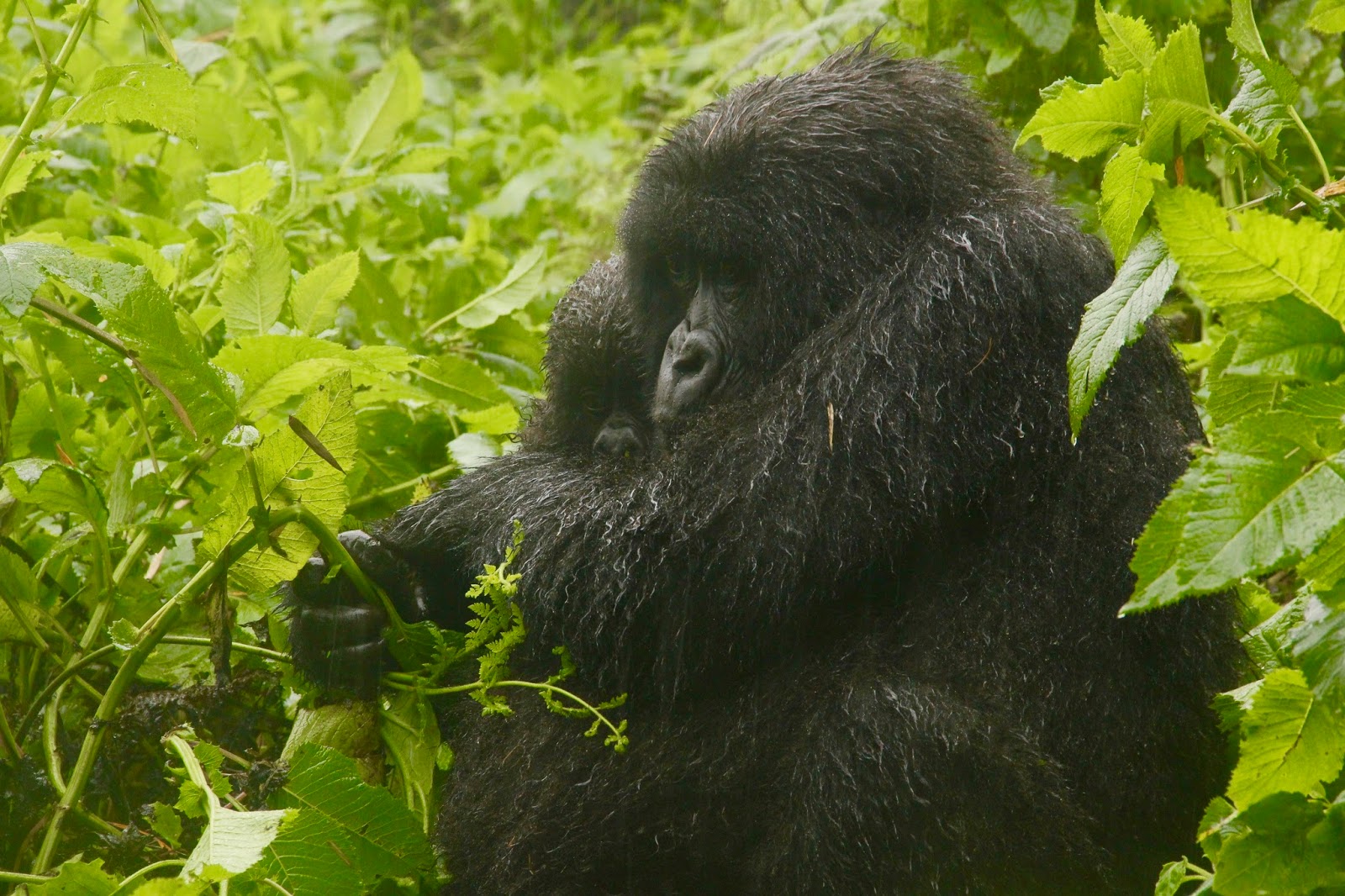
Holy cow! I didn't think we would be so close. I imagined that tracking a gorilla would be done from some distance. But I was wrong. Every encounter with a gorilla was within arm's reach. And we saw nearly 20 gorillas between both days. And although you are unable to touch them, gorillas are allowed to touch you and understand who you are and what you are doing. The only thing that you can do is make vocal sounds to let them know you are friend not foe. It's hard to find words to describe this experience.


Golden Monkeys

Before departing Rwanda, we tracked golden monkeys in the same forest in Volcanoes National Park as the gorillas. I think if we had done this on the first day (before gorillas), this would have been a much more exciting experience. After seeing the gorillas, the golden monkeys were underwhelming. These quick little guys are found in the bamboo forest area and tend to stay atop the trees. They seldom come down which make photography quite difficult and the chance for a golden shower high.


Uganda 

We spent only a short time in Uganda, but it was a great insight because we traveled a fare distance from the Rwanda border as far north as Kibale National Park, nearly 400km away. The following are just some observations and things we learned along the way.
  • Is one hour ahead of Rwanda despite being directly North
  • Rolling green hills full of farming
  • Each village is responsible for growing certain fruits and vegetables depending on the climate of their region and what their soil can handle. For example, there was a Village we drove through that grows all onions for wholesale. Another village grew all matoke (bananas). 
  • Matoke villages grows tons of bananas for sale. They are then transferred to Kampala for resale. Farmers use bicycles to transport their goods to the main road / sale / transfer area. Sometimes they have to travel from the depths of their farms just to reach the transfer area. And of course, the landscape of the area is very hilly making for a long and tiring haul. Their bikes are used only to carry the fruit and not actually ridden. 


  • Bwindi Impenetrable National Park is a Unesco site for the gorillas - half the worlds population of mountain gorillas
  • Uganda was once a colony of Britain in 1894 until 1962 when they became independent
  • The stretch of road from Bwindi to Ishasha reminds me of Myanmar or Cambodia with the quality of the road, the small villages along the way, and the poverty level


Queen Elizabeth National Park is a flat savanna with plenty of animals, which we spotted, such as:
    • Ugandan Kob
    • Topi
    • Vultures 
    • Warthog
    • Cape Buffalo
    • Forest buffalo 
    • Grey crone crane
    • Bustard 
    • Egret
    • Franklin
    • Elephants
    • Water buck
    • Baboons
    • Colbus monkey
Unfortunately, we did not see the animal that Ishasha / QENP is most known for: tree climbing lions.


We took a cruise on what's called the Kazinga Channel. It connects Lakes George and Edouard. There are plenty of animals that come to bathe and graze along the channel. It's just a giant waterhole. We've seen things like:
    • Egyptian geese
    • Hippopotamus 
    • Yellow backed river birds
    • Water buffalo
    • Crocodile
    • Storks
    • Pelicans
    • Zebra


We made a short stop at Lake Katwe, which is a salt lake where the locals collect salts for various uses. This is similar to the various salt flats we've seen around the world (ie. Salinas de Maras - Peru, Salar de Atacama - Chile, Etosha Pan - Namibia)

We did an early morning game drive through Kasenyi track. Of course we saw all the animals previously, but most notable was the lions. We saw a pride a bit spread out, but 2 males were just waking up and having their morning stretch.


With only a couple of nights left in Uganda, we too a drive North past the Equator and spent 2 nights in the Northern Hemisphere. It's funny how once you get passed the Equator, the night's sky looks a bit different. No longer can you see the Southern Cross.


There is a mountain range known as the Rwenzori Mountains that are found along the Equator  on the border of Uganda and Congo that is a UNESCO World Heritage site because it includes Africa's 3rd highest peak and is one of the original sources of the Nile River. It is also the only place in the world where there is snow on the Equator.


Chimpanzee Tracking

On our last couple of days in Uganda, we made the trip up to Kibale National Park to track chimpanzees. Similar to tracking gorillas, we had to make our way into the jungle with an armed guide and some spotters. On our arrival at about 2PM, we were paired with a veteran chimp guide. His name was Silva and has been guiding for the past 26 years. He took us into the jungle after a quick debriefing and said that it could take hours before we spot them. And timing is everything. Depending on what time you track, they could be on the ground resting or in the trees feeding. For us, we were in luck. And I do have to say that we were lucky because when we started we joined a couple who had been tracking since 6AM and didn't see anything until we met with them. It was the tail end of their time on the ground, so just 30 minutes into our trek, we spotted a family on the ground.


Families can have up to 100+ members, and in this forest there are 15 families. A number of families are for research, and the family that we were tracking was for observation by tourists. Our first encounter was with a couple of females and a baby. They were less than 3 meters away and just playing around on the ground. There was also another young chimp that was playing with the baby. They look so similar to humans. Our guide told us that chimps DNA are 98% the same as human DNA, while gorillas are 97% like humans. The visual similarities are uncanny. We were able to watch them for a short while, maybe 45 minutes? But then I think they got tired of us and started to climb. We continued to watch them climb way up into the trees and cross over from tree to tree. On the ground, we tracked their movement making our way through the jungle while keeping an eye on them. They eventually came to a giant fig tree. It was feeding time! And all of a sudden, we started to see other chimpanzees from all directions make their way to the same tree. The family was congregating for dinner! Haha. By this time, they were so high up that all we could see was movement and not the details. We could see them move from branch to branch feeding on figs. And after a little while, we decided to head off and leave them be.


The chimpanzee tracking was certainly a cool experience. But the fact that they move so quickly and climb so high made it difficult to really see or observe (even photograph) them for long. Even if they had stayed on the ground, we would have only been able to stay with them for 1 hour max. In any case, it wasn't like the gorillas (in my opinion). And in our case, they didn't come to check us out and observe us. Haha. 

Tuesday, April 11, 2017

My Myanmar is a Beautiful Burma

We spent only a few hours in Yangon and the people have been helpful and pleasant to speak with. The airport is stunningly clean and well maintained; it's also the coldest I've ever set foot in with the least number of people (the domestic side, that is). It's too bad we will not spend any real time in this city as we've opted for the roads less traveled in Myanmar.

Our transfer to Sittwe was smooth. The Sittwe airport was even less developed than the one on Easter Island. The single building here was literally still being constructed or refurbished. Strangely, after a domestic flight, we had to pass thru a quasi immigration control table to document our visit. The officer was courteous and, in his limited English, was able to give us an idea of how much our tuk tuk ride would be to the city.

The "city" is not much of a city at all. From what we've seen, there is only a single paved road. All the offshoots are dirt roads. The main establishments are on the main road, as was our hotel, a tiny place but with all the modern necessities (or what we consider necessary - a/c, toilet, electricity). The staff was again friendly. The receptionist's English was excellent, and he provided so much guidance for our onward journey to a destination much less traveled, Mrauk-U (/mra-oo/). He even packed us breakfast for our early morning departure.

Again we woke up at 5am for a 7am ferry to the village of Mrauk-U. The jetty at the river wasn't much more than a short pier of rickety wood. To get on the ferry you literally had to walk down a plank with no rails. We had to watch our step with our packs on our back and clinging on to our hand luggage tightly. The boat was old but seemed reliable. Many locals were taking the ride as well, and we sat on the top deck alongside. No one cared that we were tourists. No one stared or asked or begged. It was as if we were just like them. Is it because we're Asian? No, I didn't think so. We sat next to 2 Germans and a Frenchman, and the locals couldn't even bat an eye towards them. I wondered why. It's not like this place gets that many tourists.

The sunrises over the foggy, misty river in Sittwe. Aboard a local passenger ship, we are headed for the village of Mrauk-U.

Birds circle the ship as it sails towards the morning sun.


The 4 hour ride was mysterious as we flowed through the fog and mist slowly upriver. The land around us was pure. No establishments, no trash. Just small riverside fishing villages, raw land, and local animals doing their daily thing. And every once in a while a golden pagoda would shine in the distance.

Mrauk-U is what Angkor Wat was like 20-30 years ago or more by my estimation. Most of the roads here at semi-paved. It's very dusty. The buildings are low or shack-like. It's very undeveloped here. There are few hotels, or more like guesthouses. There aren't many cars. Motorbikes, bicycles, and tuk tuks are the modes of transportation.


Local children from one of the villages of Mrauk-U. They were so eager to be in front of a camera and to see the result. 

Buddha images at the temple sites of Mrauk-U are often reconstructed or restored. In their minds, this is preservation; I believe this idea is contrary to the requirements to become a UNESCO heritage site. 


Novice monks well on their way towards possible Enlightenment.


There are little villages in different sections of the town. Each village has a specialty. We visited villages that made bronze statues and another that weaved clothing / tapestry / and bamboo products. The people living in these villages literally have straw over their heads and live in bamboo shacks on stilts but somehow have managed to earn a living doing these various jobs. They have regular customers and regular work hours although done at the comfort of their own home. Some people even have a television or karaoke. They live a simple life without many wants, so it seems.  To power their few electronics, they use solar panels connected to a car battery to store energy. Then they somehow draw from that energy with a converter of some sort.

The stupas, pagodas, and temples all over Mrauk-U are all built to worship Buddha. Some of them have one and others have 1000s. One that we visited has 80,000+. Another had 90,000+.

Pagoda in Mrauk-U. 

Stupas in Mrauk-U.

Family-run businesses, especially guesthouses, have so much charm. They provide the comforts of a family setting, attitude, and atmosphere while giving you the professional, courteous, and prompt service required by a business. I support them whole-heartedly and financially with my patronage. We had the benefit of staying at one such accommodation in Mrauk-U called the Prince Hotel. The family was so close knit and kind. Every night we spoke with them outside at the dinner table. We played with the kids, and found out that they speak English, surprisingly well. They are enrolled in an international school in Yangon. They are so loveable. Even the family dog gave off good vibes towards the guests. Yellow (the dog's name) reminded us so much of our own dog, Kirby.

Myanmar is definitely a 3rd world country. Electricity still goes out at least once a day.

Driving in Myanmar is completely different from anywhere in the world that we've been. They have the steering wheel on the right side of the car, BUT they also drive on the right side of the road! How can they navigate the median in the street? It's strange but it works here. They must be more worried to not fall off the edge of the road and damage their tires.

The Chin villages in the Chin state of Myanmar are some of the most remote places we've ever been to in all of our travels. It is a 2 hour long boat ride up river from Mrauk-U and it's unlike anything we've ever seen. The land is in its natural state. It is unharmed by the big businesses. The villages and its people survive on what they grow, what they fish, and what they can buy from Mrauk-U and transport by boat. They are self sufficient. The only bit of technology they have are solar panels which they use to power the few televisions in the village. Villagers still use wood stoves to cook. Their livelihood is based on manual labor such as weaving clothing or baskets or small goods for sale to the larger towns. They also cut down bamboo to be sold downriver. Lives are sustained in simplicity. And there is little trash strewn around the land. It's the least touristic place I've ever seen. This is what other places must have looked like before the advent of tourism.

In some ways I would hope tourism was limited to preserve the natural culture. Is Bhutan this way with the daily fee?

A conversation with our guide tried to persuade him to believe that tourism would hurt their economy. We advised that the more people who visit, the more problems with waste and with maintenance of the natural environment. There is an optimism for more money. The reality is that once big business arrives, the small operators will have trouble keeping their jobs. Money will not necessarily stay with the locals. And if the Chinese arrive, there is a certainty that chaos will ensue and tourism could possibly destroy what is left of their beautifully kept state. Just our opinion and what we've experienced in other more touristic places. The guide on the other hand was much more optimistic. And it's understandable. He thinks they will get more out of it. That money will improve everyone's life. And yes, while it's true there will be improvements, in some selfish way I hope that the original ways are preserved somehow. But sadly, I know it will not. And the wheels are already turning. An airport's construction has already begun. Only time will determine when the changes will follow.

Met a Frenchman on our way to Mrauk-U and befriended him. It started out with us just asking if he wanted to share a tuk tuk to the village to save money. He agreed (along with the 2 other German women), and the friendship sprouted from there. Laurent joined us on the tour to the Chin villages to photograph the tattoo face women. He is a photographer living in Siem Reap doing photo tours. Laurent is a pleasant man with good humor and a love for photography that is evident. He seeks out view points and shoots great photos. He is adventurous as a solo traveler in a foreign place but is easy going and adaptable to his environment. Safe to say, we've friended him on Facebook and followed him on Instagram.

Tattoo faced woman tending her cows made time for us to interview her. She rents her cows to farmers to help plow their fields.

Tattoo faced woman who also has the enlarged earring hole as some others commonly have. 


The few tourists we've encountered here we've spoken to and befriended. Some are very avid travelers and others are just starting out and learning the ropes. In either case we've had fun conversations and in the end decided to keep in touch. Facebook FTW.

We went for sunrise with Laurent up to Discovery Hill. At 5am we took to the unpaved streets on our old, rusted, fixed gear bikes into the darkness. As the view point didn't open until 6am, and we wanted to setup before the 6:15 sunrise, we committed a petty crime by hopping the fence and climbing the hill. We've seen photos online of a mystical view of the land shrouded in fog and mist, so we wanted to duplicate the experience. Unfortunately, the conditions were probably not right. We didn't have as much mist but we were still able to capture great photos. We realized that in addition to fog and mist, the cloudiness must also have consisted of the burning of wood or rubbish, adding to the veil of smoke. It was still magical in it's own way. On our way down the hill, the attendant said nothing. He must have known that we were up there and this must happen often. He had nicely placed our bikes within the compound, so we just picked up and biked away.

Sunrise over Mrauk-U from Discovery Hill. It wasn't the most spectacular view we've ever had, but it was still mysterious with the shrouding of the fog, mist, and smoke over the village. 


I didn't know that the British colonized Myanmar. Their occupation ended in 1958. I don't believe much influence is evident here besides English being spoken by few. I also didn't know Portugal had trade here. Their influence can be found in the Christian Burmese.

Make sure you have clean, crisp new dollar bills for use in Myanmar. They will give you difficulty in exchanging them if they are not pristine and older than 2013. They should not have any creases either, so don't put them in your wallet and always carry a billfold. Annoying! No billfold wallet for me, so we just sandwiched our money in a book to flatten it out. That worked well enough.

Young Burmese boys learning to navigate the river. 


We traveled from Mrauk-U back to Sittwe by 4hr boat then took a 1.5hr flight to Yangon to stay overnight and then another 1hr flight to Heho followed by a 6hr mini bus ride to the town of Loikaw. Yea, that's a lot of travel. That last leg was most interesting because it was all locals. We were one of them. Different people got on and off the minibus at different points along the way. And this minibus literally went door to door. All our bags were strapped to the roof and the inside sat 15-16 people. It was more of a van than a bus. In terms of comfort, it wasn't the most comfortable ride, and we didn't have A/C! Thankfully it wasn't humid or sweltering hot. The open windows gave a good breeze as we zig zagged our way south. The road was single lane so oncoming traffic was like a game of chicken each time. It was mostly tarred and paved though the edges were rough and bumpy. There were also so many twists, turns, and curves all the way through. In terms of scenery, it was constantly changing. There were really dry areas. There were lush areas near the lakes. There were hills that were barren and there were towns that were full of life. Most of the towns centered around the main road running through it a bit like those roads in New Zealand.

Monks in training for an Abbey Road album cover. Just kidding.

This lock neck woman was one of the first we met. Her family is large and unbelievably poor. She was left in the village to serve as caretaker of their land while her children ventured off to Thailand for greener pastures. 


We visited Pan Pet village where the Kayan long neck women live. They are most famous in northern Thailand where they have been popularized but they are really from here. Their village is really far from any other civilization. But they've come down from the mountains over the years. We had to travel about 1.5hrs out of Loikaw to reach the village. Currently there is no completed road so we had to drive off-road on gravel and dirt to reach them. However, the government has created a project to pave the way. In one sense the road is for bolstering tourism and the secondary effect is it will connect two previously disconnected villages.

We learned that with better education less and less women want to use the brass rings to elongate their necks. And some even do it just for show, for tourism. So it is increasingly becoming fake just to make money. I feel like with the improvement of infrastructure the government is kind of encouraging women to choose the long neck lifestyle; it's unnatural. This makes it less authentic and more touristic. If the government didn't think they could make money from the tourism of people wanting to see long neck women, they probably wouldn't have initiated the road project.

The funny thing is that the younger generation is becoming better educated by the government. Where there was only an elementary school historically, secondary education is now available in the villages. It's almost like the government didn't think about the cause and effect of the roads and school.

It's sad to know that the girls who have chosen the long neck lifestyle are embarrassed by their looks. That prevents them from leaving their village and experiencing life outside of their comfort zone. This is a secondary reason the higher education system was brought into the village.

The people of Pan Pet do not seem money hungry. They do not ask for money for their pictures to be taken. They are welcoming and enjoy the conversations they had with us. The women seemed so much more happy than the tattoo faced women in the Chin villages. The long neck women have their normal lives that they lead, such as farming and the gathering of fire wood, or even working on the road construction. Some cook for their families and raise children, some weave or knit clothing and accessories, while others have small convenience stores for the villagers. It's a normal life they lead not withstanding their long neck appearance.

On the particular day we were in Pan Pet we witnessed the first of the long neck women's homes be provided electricity. The village has only run on fire and solar power until today. The government has put in place the infrastructure (electrical towers/lines through the village), but today was literally was the first day of artificial light.

Despite how little money people have and how difficult life may be in the villages, homes can still be built by brick rather than the traditional bamboo and thatched roofs. That's impressive. Comparatively, in Mrauk-U this was not possible with the level on income earned there.

The people of Myanmar tend not to allow ancient buildings or statues or even natural formations to deteriorate. With that said, they always restore or rebuild things that need maintenance. It is because of this desire to keep things in good shape that the possibility of becoming a UNESCO site is in jeopardy. This was most evident in Mrauk-U but also in the cave outside of Loikaw. In some ways, it's noble to try to maintain your places of worship and ancient artifacts. But in other ways it's saddening to see reconstructions done in poor taste and with a lack of real knowledge in restoration. But who are we to say? It's a really complicated situation and neither way is wrong.

I compare it with the situation regarding tourism. Do you forbid tourism to grow and preserve the beauty of the villages' natural state? Or do you allow tourism to boom and drastically alter the way life is pre-tourism? Do you allow the restoration of ancient figures and images by local artisans so that you can preserve your prayer locations at temples / pagoda / stupas? Or do you let nature take its course to wear away the hard work of your ancestors' manual labor to secure financing as a UNESCO site? These are hard decisions to make.

This cave was claimed by both Buddhist and Catholic people. On the outside is a cross and inside are Buddha images. Monks said that it was not the Gods who have any conflict, it is the people who worship the Gods who have conflict. So if the Gods have no conflict, then why should the people? From that time forward, monks have come to practice Buddhism while others have come to celebrate Catholicism.

60% of the people in Kayah state are Christian (Baptist and Catholic) while only 30% is Buddhist. Strangely, in Loikaw there are a lot of Buddhist sites despite the 30% Buddhist population. In the city, the concentration is a bit higher. In the villages is where the ratio is more true.

Our 10hr drive from Loikaw to Bagan was scenic. We passed through the villages and sleepy towns of Myanmar that seem as if they've been disconnected from the rest of the world forever, as if communication never reached them. We traversed roads without streetlights. Highways consisted of a single lane, meaning a single lane shared by both directions. It gives an alternative meaning to the phrase "share the road." Again, every oncoming vehicle was a game of chicken until one gives way and utilizes their signal to allow the other to pass while inching closer to the edge of the street without falling off the edge. Our old Nissan driven by a relatively young Burmese guy (probably younger than me) hugged the curves that carved the mountain ridges. And once we descended into the valley a stop was required to cool the engine and brakes with a quick 10 minute water bath. Every car was doing it after the descent and ascent. The first 4-5hrs seemed to go quickly but after lunch, the day seemed to crawl. From 1-4pm the sun's blaze was scorching. It's the hottest part of the day and the hardest to bear as there was no A/C in this car. The dry heat of 100+ degrees was only slightly tempered by the wind as we rolled down our windows for the entire ride. Our approach into Bagan was just after sunset. We literally chased the sun and watched it come down over Bagan in it's daily glory. Another day has come to an end but the beginning of a new town for us brings excitement.

Today, 7 April, we slept in. It was hard to catch a nap in the car yesterday. We rented an e-bike and started our temple and pagoda tour. As per usual, we opt for the DIY version. As we hopped around, we were able to see the well known sites and find the off the beaten path places. The latter allowed us really peaceful settings and in some cases temples to ourselves, which is how we much rather prefer it.

In Bagan, temples, stupas, and pagodas are much more closely clustered than anywhere else we've been. Visiting each of them can take days or weeks, and in the scorching heat, finding shade within one of them is the key to making it through the day.

Bagan is charming and can be eerily quiet if you find the right place to just sit and listen. 


Bagan, or more accurately for us, Nyuang-U is full of foreign tourists. It's like Angkor Wat. And when that happens you have a Westernization of the town. It loses its original character and what it used to be has transformed into what tourism demands. And unfortunately, where economics was previously unimportant, the supply must now meet that demand.

Tourism is polarized in a sense. Right now, and for the most recent few years, the attraction is here in Bagan. In a few years, the poles may shift to Loikaw or Mrauk-U. But for now, those remain in their true character. Those villages retain their unique qualities void of the economics of big business. Their true beauty shines.

No Fs given. This elderly woman allowed us to photograph her without hesitation. With thanaka cream on her face and cigarette in hand, nothing could bother her. 


We still have to go barefoot around the temples here but at least they are clean and maintained. And most people wear sandals everywhere. The worst case is that peoples' feet are dirty from dust and not dung from wild cows like in India. Just saying.

Our last day in Bagan started with a great sunrise at just before 6am. There aren't as many tourists as Angkor Wat but certainly more than Mrauk-U and Loikaw. Atop the Shwesandaw temple we watched the sky brighten and change through the different hues of red and blue. We were fortunate enough to see hot air balloons rise up from afar and drift just over our heads. Before 8am we headed for the local market to catch breakfast at a stall serving mohinga, a traditional Burmese noodle dish. And then it was back to the hotel to rest before our early lunch and afternoon massage. We rounded out our day with a couple more temples to complete our list and opted for an early dinner so we could pack up for our next adventure destination: Bhutan.

As the sun sets on our time in Bagan, we look forward to cooler weather in Bhutan.