Showing posts with label Citizen of the World. Show all posts

Wednesday, December 20, 2017

When Harry Met... Jesse & Carolyn - A Look Back At Our Time In New Zealand

Around this time last year, we were just beginning our time in New Zealand. Most of it was spent on the South Island, but we did take a few days to get a feel for the North Island. Besides the quad we rented on Easter Island, this was the first time on our round-the-world trip that we rented a car. And it was also the first time that I'd have to drive for an extended period of time on the opposite side of the road (for us Americans that is).

When I think back about Auckland, I recall the diversity all around. Like any other city, there was a certain hustle and bustle about the streets, although nothing like NYC or other metropolitan areas. It was less crowded but city nonetheless. I remember being able to walk anywhere from our home away from home for a few nights at the Kiwi International Hotel. However, there wasn't anything that stood out or was unique about Auckland. Come to think of it, although it was early in our 6 months, this was the 2nd time (the 1st being Santiago, Chile) that we felt like visiting cities wasn't as interesting as getting away from them.

Cities are a comfort. They make you feel safe and have the ability to reach things quickly to prepare for the off-the-beaten path jaunts. For us, they were landing and lily pads - airports to fly into and out of. Cities were / are our gateways.


Waiheke Island was a wine lovers paradise. The public transportation was perfect for shuttling around wine sampling tourists and locals alike. Food, drink, and beach were all within footsteps of each other, making for a wonderful day-trip from the city life of Auckland.

But Rotorua was where we relaxed the most on the North Island. The hidden hot springs were the highlight after the nearly 4 hour (but visibly beautiful) drive South from Auckland. Each one we visited was unique in location and atmosphere. Some were easy to get to, but others required keen sense of hearing to follow the faint sound of small waterfalls. It felt great to be in touch with nature at its finest. The warmth provided by the Earth was like a hug from a loved one. And the beauty of the surroundings was calming. I wish I could find a place like this in America that wasn't commercialized. The fact that the natural hot springs were free and ungoverned was the best part.

After winding our way around Auckland, Waiheke Island, and Rotorua. We jumped the puddle and landed in Queenstown. It was from here we started our driving tour of the South Island. We nearly circumnavigated the island if not for the last leg which we took the TranzAlpine train from Greymouth to Christchurch.


If there's anything I can say about the South Island it's that it is the epitome of the great outdoors. Mountains, trails, fjords, rivers, lakes, trees, shrubs, and wildlife are all in harmony here. And people here have the utmost respect for it all. Driving around it's hard to do anything but marvel at the tranquility of everything around you. Every town was a sleepy town, or so it seemed because people seemed minimalist and cared more about not disturbing the peace than collecting tangible objects.


It was in Greymouth that we met one of the most interesting and amazing people from our entire trip. His name was Harry. He was the proprietor of the hostel we were staying in called Noah's Ark Backpackers. Harry moved to New Zealand from Germany out of fear from the disaster at Chernobyl in the former USSR (now Ukraine). He wanted to get as far away from the toxic problems of Eastern Europe as possible. When he asked a travel agent what was the furthest place he could go, the travel agent offered up New Zealand and off he went.


Harry shared his life stories with us over a few beers. The pursuit of happiness was the common thread he weaved. Whether he failed on succeeded, he did as he pleased. He was amazing in that he was a professional of some sort (I thought engineer) but he was also a pilot who rode a motorcycle on the Autobahn during his yearly trips to Germany who drove a Mercedes around Greymouth and is now a hostel owner. Harry played his guitar at the reception desk in the mornings during breakfast time and smoked a cigarette on the back porch of the hostel while engaging with his transient residents. He was a man of dreams, but more importantly, he made them come true.

We shared our story with him, our ideas and goals. And all he could tell us was that we should try whatever came to mind. Harry was inspiring. We kept a lot of the things he shared with us close to our hearts and in our minds throughout the travels. It even became like a reference for us. If we ever encountered a decision to do or not do something, we would ask ourselves, "what would Harry do?" And more often than not, we were doing it.

We'll never forget Harry and the impact he's had on our lives since we met him. We hope he's doing well and continuing to live an exciting life.


Sunday, November 12, 2017

Southern Comfort Without The Alcohol

The South is really well known for their hospitality and kindness. I've always known this. It's portrayed on television, in the movies, on Broadway. You read about it in novels, magazines, and other literature. You even hear it music and as you walk down the street of any city or town South of Washington DC. I now know this for a fact from experience.

On the one bright, sunny and seasonably warm Saturday we were in Charleston, we made the obligatory stop at the farmer's market in the center of the city at Marion Square. After perusing the various food, small crafts, and boutique stands we decided to get a fresh cup of locally brewed coffee and sit around to people-watch for a while. As a couple of the lawn chairs and table opened up, we hurriedly claimed it. There was only the 2 of us, but it had seating for 4. Less than 5 minutes later, a couple and their teen rolled up and asked if they could share the table. We happily obliged and the father pulled up a 5th chair.

For a couple of minutes, Carolyn and I spoke between ourselves and so did the family in between bites of their breakfast. But shortly after that, Carolyn and I, almost routinely, turned to them and engaged them in a conversation. We had fallen back on our travel habits that had grown on us during our time abroad. At first thought, these people could hate that we interrupted their meal, but on the flip side, they did ask to share our table.

We learned that they were actually transplants, not originally from Charleston. They were travelers and had lived in multiple locations over the past few years, including Germany, Japan, and Portland, OR most recently. The husband was actually from Nepal! We immediately connected on so many levels. It opened up the can of worms that is travel.

For the next hour, we talked, shared, and exchanged stories but failed to swap contact information. It wasn't important. We spoke about trekking to Base Camp, eating Japanese food, their son's love for soccer, moving around, fresh food and farmers' markets, and anything that was tangentially related. The pleasure of talking about travel, experience, and the future was enough to keep our minds occupied. It was refreshing and fun to meet new, like-minded people.

Funny enough, we knew we'd meet friendly Southerners. But to have met such great transplants that are now Southern by residence was a real treat. Maybe all the friendly people move to Charleston or other points South? (431)


Wednesday, October 11, 2017

The World Doesn't Stop For Anyone

It is so strange being out and about during the weekday. Not having a job has really showed me that there is more going on in the world than work. When I was fully employed in corporate America I had this stupid notion that everyone must be working at the same time and few people should be out and about. I mean come on I knew other things were going on. I was just never accepting of that fact. Surely if I was working then everyone else was too, right?

I think as a young adult entering corporate America, you are blinded by the fast pace, the number of people competing, and the grandness of NYC. So naturally you want to move just as fast, feel as important as the next person, and fit in to the hustle and bustle of THE city.

For the longest time, I was a robot. Wake up at 6:30AM. Get ready for work. Catch the 7:15AM bus. Ride the subway. Arrive at the office. And commence your work duties. 12:30PM grab lunch. 7PM try to escape work to get your evening tasks accomplished before the doors close on you for the night. Whether it be grocery shopping, cooking dinner, picking up the dry cleaning, making a Home Depot run, or hitting the gym for the 3rd night this week to let off some steam and stay in shape - it's a nightly challenge to beat the rush hour commute home. And god forbid you have to go to the post office; you'll have to fit that into your lunch hour tomorrow.

What I've learned from travel and from being unemployed is that life goes on. Corporate America is a bubble. NYC lives by its own rules. It breeds a certain kind of person. The city harbors some of the most amazingly intelligent people and is ruthless for anyone who can't hack it. Maybe that's why I love it so much. I feel like I fit in. Or at least I try my hardest to and have had success doing it.

The competition is such a driving force. To be challenged every day and to learn from some of the best and brightest is so appealing. With everything at your fingertips it's no surprise how and why the people who fit in stay forever and climb the ladder with determination and gusto. Frank Sinatra said it first and Jay-Z reiterated in his lyrics that, "if you can make it here, you can make it anywhere." It's true.

But everything else that happens in the world doesn't stop for NYC. They all carry on. Everyone has different schedules to complete different tasks. Sometimes I feel like other peoples' lives are more dynamic than NYers. Outside of NY anyone can instantly change their plans or reroute their direction to accomplish other things. But NYers, once put off track, become easily annoyed with the distraction. Or was that just me? Was I a robot because I chose to be one? Or was forced to be one to keep up?


There is so much else going on outside of corporate America that is equally as important, but those that work within the confines of the city lines fail to believe that. Or maybe I should say that the fresher faces of the work force don't yet see it. Because I believe that a good number of the veterans have a better appreciation for what lies outside of the veil of the corporate collective. Maybe it's because they have more time or better work/life balance. Whatever it is, sometimes the realization comes too late.

Once you get a glimpse of the world outside and figure out that you can make it anywhere else, you'll want to get a taste of it as soon as possible. The world is enormous. There's plenty to learn. And there are plenty of people and experiences to teach you. (654)

Tuesday, September 19, 2017

There Is Etiquette In Travel Photography

What a great article by Wendy Simmons posted to Travel & Leisure about the nature of photographing people around the world. It is no easy action to take pictures of and with local peoples in any given village / town / city. But she found a way to make a memory for both sides. Wendy broke the stigma associated with taking peoples' photos by turning the situation from a transaction into an experience. And that's what it really should be.

It's not about capturing images. It's about creating a relationship. It's about learning from one another. It's forming a bond of trust. The photo should just serve as a reminder to you and your new friend of the friendship that's been created.

And that's why I'm so happy to learn about the length she went to deliver a single photo to a family who's never had their picture taken together before. It's a vivid reminder of what true friendship can do. I may have to borrow that idea Wendy!


What most of you don't know is that there is a real negative thought linked with photographing people, particularly faces of people, in many parts of the world. The idea that fuels the angst and sometimes even anger is theft. Some believe that you, the photographer, will steal their image for your direct benefit, that you will sell their photos to make a profit. The people of this mindset do not want to be exploited by foreigners. They do not want to be taken a fool and not be properly compensated for it. And for those reasons, people avoid posing for a quick snap. Some demand money for the chance of a photo with them. And others just plain don't allow it.

These fears and the anger are not unwarranted. Many a people have been used for their images never to be compensated, never being asked permission, and seldom having ever developed any kind of relationship. It's a sad truth in the generation where photography is almost like race or a game to capture the most remarkable, seemingly unreal but true images around the world.

Bottom line is that photos taken of people should be by permission. It is most preferable that an interaction precedes the capture. And it would be the best to develop some kind of relationship and understanding between all parties. There's plenty to learn from people around the world. You never know what kind of insights you'll get. And I'm certain that some of them will amaze you.

We made some great relationships along the way on our tour of the world.  Just have a look at these faces.


Monday, June 26, 2017

American Dream?


Ever since we returned home, all I can think about is how challenging the American Dream really is to achieve. There are many other people around the world who imagine that coming to the United States would make their lives so much easier or allow them to live with so much more freedom. While that is a true change for some people, others should really stay where they are because of how good their lives would / could be in their country of origin.

I've told countless people abroad that their perception is not reality. How so?

Some people have said to us that they believe there is so much freedom in the USA. And I've replied that yes, there are freedoms, but there are so many laws, rules, regulations, by-laws, and other stipulations that need to be abided by while living here in the USA. When I asked them if they have such regulations, many were quick to think and respond that there was no such law in their home country.

When the case of education came up, many cities and countries have found ways to make education free for their citizens. If not free, then at least it was very inexpensive which allowed for many common people to become educated without breaking the bank. When I told them the local currency equivalent of an average education in the United States, these people were sticker shocked at the absurd amount necessary to obtain a diploma.

For me, the follow up to education was logically the issue of debt. Students in the United States expend so much of their capital on education, and then suffer through unemployment or subpar work because either the market for their chosen profession is oversaturated or they are still not qualified for the work they intend on doing. Then the vicious cycle begins. They can't pay their debt, interest is added, time passes, their total debt increases. And once they obtain a decent paying job, these new workers want to enjoy their money. Many spend on clothes, cars, entertainment, and food which leaves little to pay down their initial debt in the first place. And the cycle continues. Debts and interest compound making it years before a former student can ever be relieved. And as their lives progress, their debts seemingly always increase. The next steps of their lives leads to significant others, then engagements and wedding, followed by growing families. Americans live by constantly owing someone or some institution a sum that reduces at a fraction of the speed at which it grew (exponentially). 

So what have the people around the world said? Many have said their piece to me about credit and credit cards. The main issue is, "how can you spend money that's not yours?" Or they wonder, how can the government or financial institutions allow people to have such tremendous debt? Others have expressed concern over the impact it has on the mindset of the people and the cyclical nature of the system. And for me, I've identified another issue with debt. The idea of debt prevents many capable people of pursuing education for the sheer fear of having debt and the inability to pay it off. And uneducated people means a lifetime of poverty (relative to their environment) and/or future struggles; yet another unfortunate cycle that stems from an unfortunate cycle. 


Which leads me to my real point. I am an American by birth, but a citizen of the world in mind and in heart. And I've been thinking so much about my American Dream. For many years, I wanted to follow in the path of the majority. I wanted to graduate from a top notch university; I did that. I wanted to own a car; I paid it off in 4 years rather than 5. I wanted to own a home and grow a family. And this is where I've stalled somewhat.

At the age of 24, I purchased my first home, and I am currently financing it over 30 years (21 left) with some moderate interest rate. I spend a fairly good chunk of my salary paying for this home. But I spend most of my time in an office over an hour away from the home where my money is sunk. How on earth is this a justifiable way spend hard earned money? 

Is this really the dream I wanted? No way! Why am I spending hundreds of thousands of dollars on a place where I spend less than half of my time? Why am I trying to fill my home with dead space or useless items of decoration? Why am I struggling to spend on other things that matter like continuing education, organic food and better health, or life experiences and culture? 


I am having a hard time coming up with good reasons to keep doing what I'm doing for the reasons that have previously been dictated by popular culture or merely precedent, here in the USA. 

I feel a change coming... 


Friday, June 23, 2017

Superlatives


We saw a lot in the course of 6 months. And some of these places really impressed us. So let me get my Julie Andrews on because these are a few of my favorite things: 


Favorite country: Bhutan - http://www.tourism.gov.bt/


Favorite People: New Zealanders (Kiwis), with Bhutanese and Burmese in a tie for a very close 2nd


Favorite Site: Angkor Wat (Siem Reap, Cambodia) and the Moai (Easter Island, Chile) in a close 2nd

Favorite Food Culture: Singapore had a great variety of food options that ranged in price from unbelievably cheap to Michelin 3 star expensive. 

Best farmers market: Margaret River, WA, Australia - https://www.margaretriverfarmersmarket.com.au/

Best Street Food Market: Brisbane, Australia - https://eatstreetmarkets.com/

Most memorable experience: Witnessing the long-neck women in a small village in Pan Pet, Myanmar switch on a light bulb with constant running electricity for the first time. Previously, they used fire, candles, and in some cases solar power.

Best topography: Cape Town, South Africa

Most well connected to the internet: Australia

Least connected to the internet: Myanmar 


And to change it up a little bit, the things I missed the most were: our dog - Kirby and my Tempur-Pedic pillow


There were so many great sights to see, people we met, experiences had, audible languages, hand gestures, facial expressions, exchanges of ideas, cultural experiences, food journeys, and starry nights. But these were just a few from a laundry list of wrinkles in my mind. 

If I could experience them again, my life would be twice as grand. 

Monday, June 19, 2017

Driving Around The World

Facts & Observations

Only about 34% of the world drives on the left side of the road. See the complete list here. 

Nerdy-ly, for my own knowledge, I took notes on the driving side for each country along with the side of the car in which the steering wheel was located. In most situations, the steering wheel was on the opposite side of the driving side. For example, in the United States, the steering wheel is on the left but we drive on the right side of the road. Only in one case was I so shocked to see the driver and the side the same... Myanmar. Here were my observations: 


Whether you drive on the right or the left, it seems most logical to have the driver on the opposite side (driver left, right side of road). That way, you can see the median lines and oncoming traffic much clearer.

But in Myanmar, it seems like it was still logical to drive on the right side despite the steering wheel being on the right side as well. I say this because the roads are so poor that in many cases the edge of the road or gravel had some drop offs or lips. To prevent from "falling off" the road, it makes sense to have the driver on the same side of the road as his steering wheel. That was my theory before I did any research.

But here's the funny reason why they drive on the right and have the steering wheels in their cars on the right as well. Read it here.

From Experience...

I did a lot of driving in various countries around the world. It was some of the most fun we had, and at the very beginning it was something very challenging to me. Even though I had driven on the opposite side of the road (left, instead of right) in Japan before, that was for a very short time. On this trip, extended parts of our journey were spent on the other side. The most driving I did was in New Zealand, Australia, and Namibia, where I drove over 3,000km (2,000+ miles). 

Where have I driven and what I drove:


Some of our rides... 


A post shared by Carolyn Go (@carolynluu) on 


Monday, June 5, 2017

RTW By The Numbers


180 - # of days abroad

4 - # of continents visited (if you count our layovers in Europe, then it's 5)

17 - # of countries visited

48 - flights taken

47 - different Airports departed from or arrived into

25 - different Airlines flown

38% - of the total cost related to airfare

1/3 - fraction of the total cost related to accommodations

$27.31 - average cost of accommodations per person per night

28 - # of days in Australia, the longest duration we stayed in any one country

4 - # of days in Singapore, the shortest duration in any one country

29% - of the total cost related to other expenses, including food

7 - # of Michelin starred or San Pellegrino listed restaurants dined along the way

8 - # of Visas required and applied for or provided upon arrival

9 - # of countries where I was able to drive a vehicle (ATV, motorbike, automobile, e-bike)

10 - # of friends who met us along the way

8  - # of haircuts (in Australia 2x, Indonesia, Vietnam 2x, India, South Africa, Rwanda)

40-109 - in degrees Fahrenheit, the range of temperature endured along the way

Countless - cities/towns/villages visited, kilometers, driven, hours traveled, buses ridden, trains embarked on, new friends made, contact information exchanged, sites seen, experiences had, meals eaten

Priceless - memories made, photos taken, feelings had, minds expanded, imaginations captured, discussions fostered

Tuesday, May 30, 2017

Our Last Stop Around The World: Morocco - Where Beautiful Traditions of Islam Prevail


We had a long trip from Rwanda/Uganda just to get here. There were no direct flights, and the most reasonable (price and time) forced us to fly via Brussels, Belgium and Lyon, France. With connections, it's always a risk to miss your next flight or lose your luggage. Thankfully, the only problem we had to deal with was in Lyon, where the airport was severely short-staffed. They did not have enough security to process all the passengers in our terminal. Add to that a police issue in the city that detracted some officers from their normal post in the airport, and you end up with severe delays. For us, that was 3 hours.

On our arrival into Marrakech, there was a terribly long queue for immigration. Officers were just taking their time to process hundreds of people. And there were only 5-6 officers to vet each passenger individually. Fortunately, once we got out of the airport, it was just a short ride to the old city, or the Medina, to our riad. And we were able to just spend our first evening in Marrakech recovering from our series of flights and delays. A riad is a traditional Moroccan house with an interior garden or courtyard. Our's was beautiful, although cozy, but so decorative that it distracts you from the size and mesmerizes you. Many riads also have rooftops that are accessible and give great views of the city.


-------------------------------------------------

People here wake up late. And things open after 9:30am. I believe it's because people are really trying to avoid the midday sun and stay up late for work and entertainment. Many even eat late in the evening because they take naps in the middle of the day for the same reason.


-------------------------------------------------

The Medina in Marrakech is a series of alleyways that, for the most part, restrict vehicular access. It's pedestrian, save for the occasional motorbike zipping through. Everything in the old city is walkable within 20 minutes, and it is very safe, even late in the evenings.


There are few main attractions in Marrakech, which we like. Jemma el-Fnaa is the main square. You can find food stands and plenty of good for sale. Every stall is marked with a number so you can remember who has what and how good that product is. If there's anything you have to get in Morocco or even this square, it's a nice glass of orange juice. At 4 MAD ($0.41) for a glass, it's the best deal you'll ever get. In fact, just get 2.


And not so far away is the Ben Youssef Medrasa, which is the the largest college in Morocco. It is fun to walk through the school and pop into and out of the former dorms of the students.


There's also Bahia Palace, one of the many palaces in the city, which is supposedly the most beautiful. And you can spend time a short walk away at the Saadian Tombs where the former sultan and his family are buried. Its beauty, like that of Ben Youssef Medrasa, is in the decorative artwork.

It's simple to visit the sites in a day and then spend the rest of your time wandering the streets, eating the local food, saying hello to the shopkeepers in the souks, or marketplace. Or if you want to treat yourself, an afternoon at a hammam will relax you, clean you, and keep you out of the heat.

-------------------------------------------------

This is our first predominantly Muslim country on this trip. There are consistent calls to prayer coming from the numerous mosques at scheduled times throughout the day. In the small villages, 10-12 families share the mosque. Mosques even serve as places to host guests of the village.

-------------------------------------------------

Morocco's Southern and South Eastern areas are mostly desert but the Atlas Mountains that cut the country diagonally have snow in the winter. This mountain range somewhat serves as a border between desert and non-desert lands.

-------------------------------------------------

Tajin is a clay pot used to cook delicious authentic Moroccan dishes with various spices for full bold flavors. I can't tell you how many tajin dishes we've eaten along the way. Haha.


-------------------------------------------------

For 4 days and 3 nights, we arranged for a desert tour. Our guide, Hamid, was very informative but at the same time, gave us the space we needed to explore, take pictures, and enjoy ourselves. There's plenty of driving to do just to get to the desert. First you must pass the Atlas and then you traverse Southeast towards the small village of Merzouga, near the border of Algeria. Along the way, we made stops for the first 2 nights. The first night was in Dades Valley and the second was closer to Merzouga. The last night we spent in at a nomad desert camp in the Sahara.


Some things we learned about the villages along the way:

  • Sunday is market day
  • Transport goods to mountains on donkeys
  • Coffee is from Ethiopia
  • Tea is green tea from China
  • Mint tea is only for summer
  • The tea is poured from high up to cause bubbles because otherwise, it's just water.
  • There are 4 main languages spoken in Morocco: 
    • Arabic
    • French -2nd language taught in school
    • Berber
    • Spanish
    • AND many people speak all 4 or more! Many people speak so many different languages here. It makes the United States seem so poorly educated. The restaurant guys can all speak at least 5 languages and can say various words and phrases in many other languages. It's quite amazing.
  • Argan oil is similar to olive oil or almond oil with many uses such as cosmetic and cooking. The taste is light if in oil form but can be like peanut butter, thick and pasty, if using the actual nut as opposed to extracting the oil. 


We visited Aït Benhaddou, which is a village between Marrakech and the Sahara Desert. Inside the walls of the village are half a dozen Kasbahs or merchants houses. It's a great example of Moroccan earthen clay architecture. This place is most famously known for being the location of many films being shot, including Gladiator and The Mummy.

-------------------------------------------------

On our drive, we passed by a solar power panel project in the desert. Supposedly, by 2020 it will provide power to some places in Europe. It's like a solar panel farm.

-------------------------------------------------

Beginning in 2017, a ban on the use of plastic bags in Morocco is in place, similar to the efforts in Rwanda.

-------------------------------------------------

Observations:

  • Dades Valley is lush green on The Valley floor but anything else is the reddish brownish rock / sand color of the desert. The surrounding mountains are all dry and mostly barren. It's such a contrast of colors.
  • Dades Valley has fig and olive trees. Todra gorges has palm trees.
  • Valley of the roses. Women collect the rose flower early in the morning before the desert sun dries them or forces them to close. Evenings are cooler and allow them to bloom. Roses are used to make various products like rose water or oils or other cosmetics. Products are exported from here.
  • Most structures here are built in block forms. There are no round shapes for any building.
  • Dromedary are like camels but with only 1 hump.


-------------------------------------------------

Oasis land is shared by up to 400 families to grow palm, dates, and other vegetables. Each family gets a small square of land to work with. The water comes from below the sand dunes and is channeled to the oasis. It is potable. I always thought that an oasis was a false sighting of water or something in the desert. It turns out, that's a mirage.


-------------------------------------------------

Riding through the Sahara desert on a camel is different from any experience we've had before. Yes, we rode camels in Mombasa, Kenya on the beach but going through the desert is a bit different. You go up and down the sand dunes and feel the animal balance itself and struggle on the uphills and carefully navigate downhill. They don't seem to be the most surefooted but I've never seen one fall either.

The wind in the desert is constant and gusty. You constantly get sand in the face. It sticks to your hair; you find it in your ears. It's impossible to get out of anything without a proper wash. In some cases the wind swirls and you get a tornado in a sandstorm. It's pretty painful to constantly get pounded by sand. Getting it in your eyes and mouth are probably the worst. The only way to prevent it is to wear proper attire. Sunglasses and a scarf or face cover are necessary. If you can get a turban, that will cover your head and face very well also. Turbans also keep the warmth of your head during cooler nights and cold winters.


Our camel ride was about 30 minutes to get to a lookout point where we could sit out on the dunes to watch the sunset. By 7pm the sun was falling below the horizon. It was then that we started our last 30 minute journey to the overnight camp.

A night in the desert after our camel ride was very comfortable. We were out up in a luxury camp. We had a tent with a kind size bed and even a bathroom with shower. Dinner was served in a dining room tent, and we shared this time with some other guests. After dinner, we sat outside by the campfire and listened to some music provided by the locals and workers. Much of it was drum based, loud, fast tempo, and exciting. The stars up above were very bright in the sky.

The next morning we got up at 5am to watch the sunrise. Unfortunately, we got very little sleep because the wind woke us up at around 1am from shaking the tents and making all kinds of noise. But the sunrise peeking over the dunes was yet another beautiful sight. Sunrises and sunsets never get old.

-------------------------------------------------

A 7hr drive out of the desert took us to the city of Fez, a former capital city of Morocco. Our riad is in the Medina and very comfortable. Because of a double booking they moved us to the best room on the top floor with a great view of the city from the rooftop terrace. Because of our late arrival here, we have 2 nights but only 1 full day to do siteseeing.


On our 1 full day we did a half day tour with a guide. The main objective was to see the souks and make it to the tanneries. The Chouara tanneries are the largest in Northern Africa. Here they produce numerous leather goods that are cleaned, colored, and designed in this factory of sorts. There is a strong smell in the area from the processing. The staff even gives tourists sprigs of mint to smell while taking the tour. In particular, they use pigeon poo as ammonia in the process and that gives a foul odor in addition to the 1000s of goat, camel, sheep, and cow skins all over the place. To color the skins they use all natural products. Orange is henna, red is poppy flowe , green is mint, brown is cedar wood, yellow is saffron, and blue is indigo. The dyeing takes 15 days after which they are dried on the roofs and then later taken to the designers to create the various products. They have bags, shoes, jackets, belts, and many other leather goods. It's an amazing cool site but the sales people are quite rude and really looking for a sale. Our guy even went as far as to say that we were a waste of time. Oh well. We didn't buy anything but there's no reason to be rude. It seemed like other tourists were coming out of there with the same experience. If it wasn't such an experience or site to see, I'd suggest that no one give them any time.


-------------------------------------------------

Not many places accept credit cards in Morocco. It's mostly a cash based system. We tried to explain the credit system to our formerly nomad tour guides and they thought the system was crazy. How could you spend money that you don't really have? Really looking into it, they system is pretty ridiculous. The country, government, and its people (the USA) all exist because of borrowed money. It seems like the place and people are so wealthy but is it even owned internally? Or is it borrowed from China? Is it borrowed from the bank? Is it borrowed from someone else? Yes. It is. If it wasn't for borrowing, the United States may be in the same condition as a 3rd world country. Right? Is America really great? Or are 3rd world countries and people that are self-sufficient greater?

-------------------------------------------------

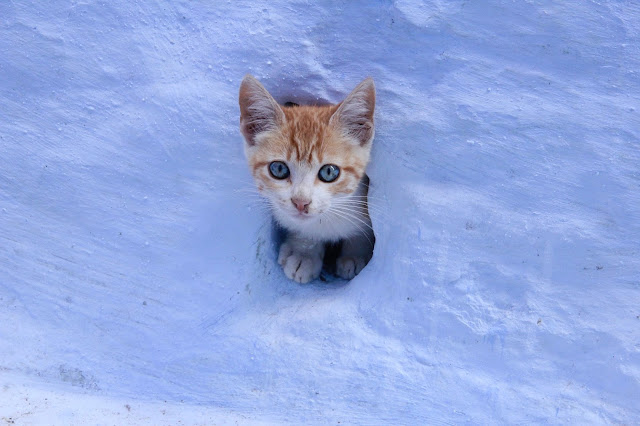
4 hour bus ride from Fez lead us to a small hillside town of Chefchaouen. It is known to most as the blue city. Most people here can speak Spanish as opposed to French. The people are friendly. There are not so many touts or people trying to make money from you. The town is quiet and peaceful. It's easy to walk around the entire Medina, or old city. It is mostly cobblestone and cars are allowed, although there are random motorbikes that zip through. Children play everywhere and are so smiley. I can't say the same for the adults who immediately seek cover when they see a camera raise in their direction.

We were in Chefchaouen on the first day of Ramadan. In the days leading up to this month long holiday, we were already hearing how people were preparing their minds for the fasting that goes on. It made us think of how difficult it is to fast if you work in the food service industry. We heard that some people even shut down their establishments to avoid exerting too much energy during daylight hours. Others planned to reverse their sleeping schedule so that they would be up all night and be able to eat and drink then sleep throughout the day.




A candid photo of the local people is really hard to get because they are so aware of their surroundings and so against their image being taken. Strangely, they believe that their pictures will be used to make money elsewhere. They don't want to be used as a cover photo or digitized and exploited in the media. And it's somewhat understandable but we're not paparazzi. We're just regular tourists trying to capture moments that are interesting and beautiful.


-------------------------------------------------

5 pillars of Islam - we witnessed some of these on a daily basis. For example:

  • A man in the street who was clearly homeless or poor was given milk and a jacket by a random stranger. 
  • The suffering through hunger on the first day of Ramadan was evident. 
  • Constant prayer 5 times a day was not so evident. We didn't see many people go to the mosques and obviously didn't have access to peoples' home to see if they really prayed. But we still have to imagine that they do this without fail. 


-------------------------------------------------

Children running around Chefchaouen were a nice reminder of what it was like to be a kid. When there was no internet and I wasn't allowed to watch tv, I played outside. I was with the neighborhood kids playing football or street hockey or riding bikes or playing basketball at the park. These kids have far less than I did, but they seem to be having fun. They chase each other through the alleyways of the Medina. They duck in and out of each other's doorways. They kick a little ball down the cobblestone streets. Adults and random parents are scolding them for causing a ruckus. Some kids are being given treats by the hole in the wall convenience stalls. It looks like fun to be a kid here.


-------------------------------------------------

Somewhere between Souk Elarbaa Du Gharb and Rabat (closer to the former) there is farmland that is specifically used for growing sunflowers. As far as the eye can see, there were acres and acres of sunflowers. What do they do with them?

-------------------------------------------------

Normally a 4.5hr ride by car from Chefchaouen to Casablanca is 5.5-6hrs by bus as it needs to make some stops. It only cost $14 per person. Had we taken a private taxi, it could have been upwards of $150. And because it's Ramadan, it's likely they would have charged more.

-------------------------------------------------

Casablanca is the largest city and financial capital of Morocco. We've learned that we're not such big fans of the cities as we prefer to be off the beaten path and in the smaller villages or towns. The cultural aspects of the city can sometimes be lost amongst the buildings, cars, and other modern amenities. That being said, we found ourselves at an AirBnB outside of the city center but walking distance to the main attraction here, the Hassan II Mosque.  This is the largest mosque in Morocco, 13th largest in the world, and it's minaret is the tallest in the world at 689ft. Unfortunately, because of Ramadan, the tour hours are limited, and we were unable to take a tour inside. It is the only mosque in Morocco that is open to non-Muslims. But the view from the outside is pretty grand. Being on the Atlantic Ocean gives the area a cool breeze while the sun beams down from above.