Kigali, Rwanda
Our impressions, observations, and things we've learned during a brief but educational stay in Rwanda.
- Very clean city - It's the first thing we noticed when we exited the airport headed to our hostel for the first night.
- No plastic bags - the country doesn't allow plastic any longer. It's part of a move to keep the country clean and eco-friendly.
- Tons of motorbikes like in Vietnam. Most of them are public transportation. You can hail a moto and pay for a ride to wherever you choose.
- Very safe - the country has very little corruption. There are no roadblocks or bribery as you travel around the country. This is quite different from say Kenya or Congo.
- Well developed - Kigali is a modern city with buildings and good infrastructure. People generally follow the rule, especially while driving. We noticed our driver moving very carefully, always abiding by the speed limits. According to him, the penalty is high if you are caught breaking the law.
- Agriculture is the first income. Tourism is second source of income.
The April 1994
genocide against the Tutsi tribe is the worst event in Rwandan history. But now Rwandans look back on it as something to learn from, something to teach their children about, and as an example for the rest of the world. We learned so much about these events from the different churches and houses of worship that created memorials, as well as from the
Kigali Genocide Memorial. The sad truth is now a form of education for the future.
Outside of the city of Kigali, it is very green. There are plenty of rolling green hills. In fact, Rwanda is known as the "land of a thousand hills."
Gorilla tracking
Permit costs for tracking gorillas in Volcanoes National Park went up to $1500 for 1 visit. Luckily we got our permits a couple of months ago and paid only half price ($750 each). And we had also made the decision to get 2 permits, so we got 2 for the price of a new one.
Tracking mountain gorillas starts with a briefing at 7am. This is when the guides determine which family you will be following. There are different levels of tracking (easy, medium, hard). The difference is how far, how long, and how difficult the terrain is that you have to trek before encountering the giant animals. On both days we were organized with medium level groups. Also on both days, we were graced with the presence of Hollywood actors! On day one,
Erik Palladino was in our tracking group. And on day two, THE
Morgan Freeman was here but not in our group. He had his own VIP group. Apparently, plenty of celebrities come to this area to track the gorillas. And now we know why. It's just that amazing.
The beginning of the trek is through some farmland that borders the National Park. You are met by porters who can be hired to carry some things for you or to help you with the walk. When you reach the border wall, an armed official joins your group to walk in front of you. His job is to lead the way to the spotters and also protect you from buffalo that may be along the way. Buffalo and gorillas do not get along so a little bit of protection is needed. The gun would only be used to shoot the buffalo in any case of harm.
Then you trek through the jungle. It's been rainy here these days so there plenty of mud, puddles, and slippery spots. On the first day, we were not so prepared. We had our normal hiking gear and rented some gators but that wasn't really enough. The next day, we opted for gumboots to trek through the mud and that made a huge difference. The hike wasn't easy. We had to climb and crawl, dodge branches, use walking sticks and vines to help us along the way. We had to trudge through nearly knee deep mud in some parts. We slipped and sometimes fell, but thankfully no terrible injuries happened. And we had to elevate through some altitude to find the hairy beasts. You can trek for anywhere from 1hr to 8hrs to find these guys. But on both days we were lucky enough to only have to travel around 1.5hrs to reach them and the same going back. The trek itself is an experience.


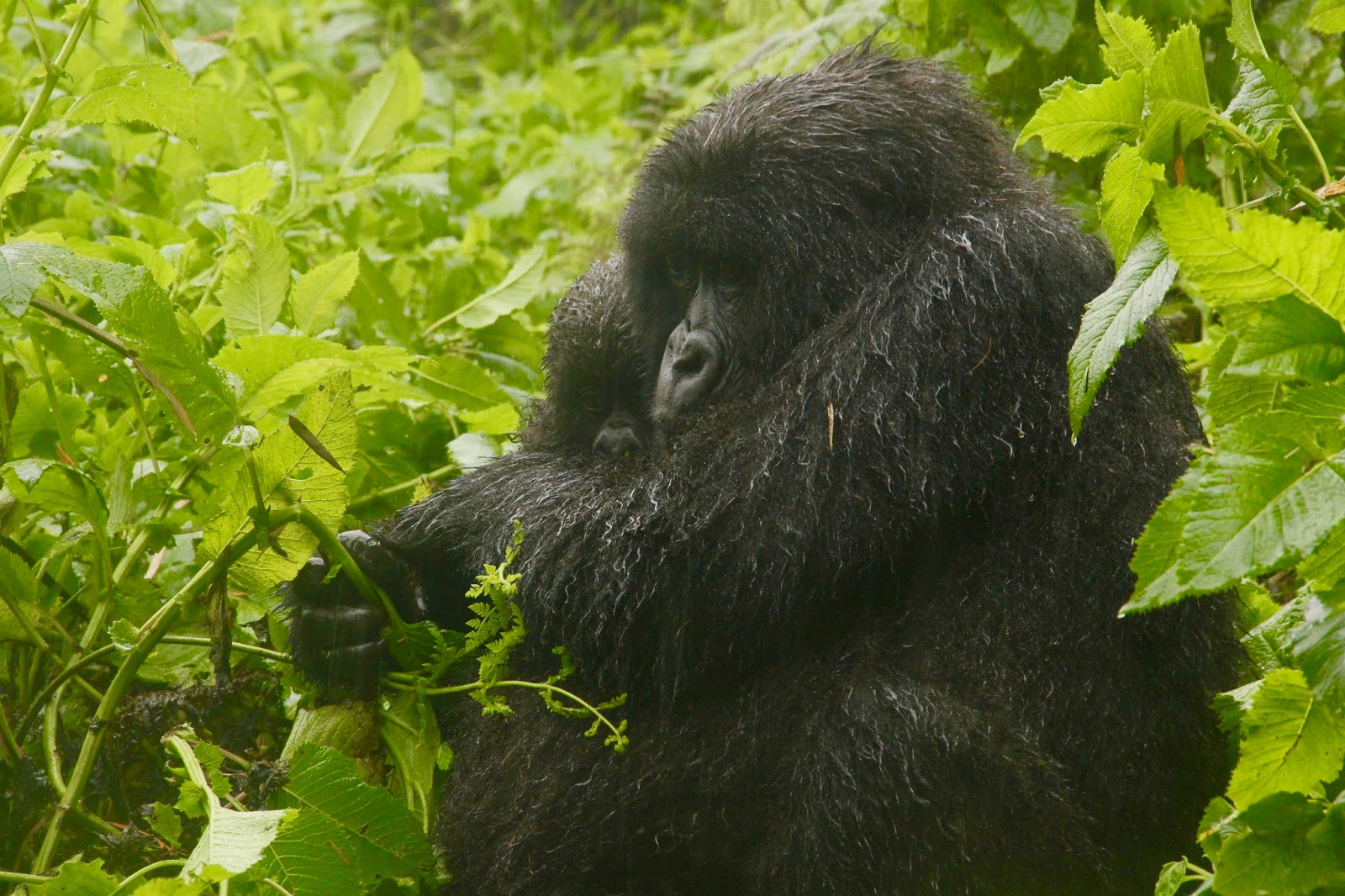
Holy cow! I didn't think we would be so close. I imagined that tracking a gorilla would be done from some distance. But I was wrong. Every encounter with a gorilla was within arm's reach. And we saw nearly 20 gorillas between both days. And although you are unable to touch them, gorillas are allowed to touch you and understand who you are and what you are doing. The only thing that you can do is make vocal sounds to let them know you are friend not foe. It's hard to find words to describe this experience.
Golden Monkeys
Before departing Rwanda, we tracked golden monkeys in the same forest in Volcanoes National Park as the gorillas. I think if we had done this on the first day (before gorillas), this would have been a much more exciting experience. After seeing the gorillas, the golden monkeys were underwhelming. These quick little guys are found in the bamboo forest area and tend to stay atop the trees. They seldom come down which make photography quite difficult and the chance for a golden shower high.
Uganda
We spent only a short time in Uganda, but it was a great insight because we traveled a fare distance from the Rwanda border as far north as Kibale National Park, nearly 400km away. The following are just some observations and things we learned along the way.
- Is one hour ahead of Rwanda despite being directly North
- Rolling green hills full of farming
- Each village is responsible for growing certain fruits and vegetables depending on the climate of their region and what their soil can handle. For example, there was a Village we drove through that grows all onions for wholesale. Another village grew all matoke (bananas).
- Matoke villages grows tons of bananas for sale. They are then transferred to Kampala for resale. Farmers use bicycles to transport their goods to the main road / sale / transfer area. Sometimes they have to travel from the depths of their farms just to reach the transfer area. And of course, the landscape of the area is very hilly making for a long and tiring haul. Their bikes are used only to carry the fruit and not actually ridden.


- Bwindi Impenetrable National Park is a Unesco site for the gorillas - half the worlds population of mountain gorillas
- Uganda was once a colony of Britain in 1894 until 1962 when they became independent
- The stretch of road from Bwindi to Ishasha reminds me of Myanmar or Cambodia with the quality of the road, the small villages along the way, and the poverty level
Queen Elizabeth National Park is a flat savanna with plenty of animals, which we spotted, such as:
- Ugandan Kob
- Topi
- Vultures
- Warthog
- Cape Buffalo
- Forest buffalo
- Grey crone crane
- Bustard
- Egret
- Franklin
- Elephants
- Water buck
- Baboons
- Colbus monkey
Unfortunately, we did not see the animal that Ishasha / QENP is most known for:
tree climbing lions.
We took a cruise on what's called the Kazinga Channel. It connects Lakes George and Edouard. There are plenty of animals that come to bathe and graze along the channel. It's just a giant waterhole. We've seen things like:
- Egyptian geese
- Hippopotamus
- Yellow backed river birds
- Water buffalo
- Crocodile
- Storks
- Pelicans
- Zebra
We made a short stop at Lake Katwe, which is a salt lake where the locals collect salts for various uses. This is similar to the various salt flats we've seen around the world (ie. Salinas de Maras - Peru, Salar de Atacama - Chile, Etosha Pan - Namibia)
We did an early morning game drive through Kasenyi track. Of course we saw all the animals previously, but most notable was the lions. We saw a pride a bit spread out, but 2 males were just waking up and having their morning stretch.
With only a couple of nights left in Uganda, we too a drive North past the Equator and spent 2 nights in the Northern Hemisphere. It's funny how once you get passed the Equator, the night's sky looks a bit different. No longer can you see the
Southern Cross.
There is a mountain range known as the
Rwenzori Mountains that are found along the Equator on the border of Uganda and Congo that is a UNESCO World Heritage site because it includes Africa's 3rd highest peak and is one of the original sources of the Nile River. It is also the only place in the world where there is snow on the Equator.
Chimpanzee Tracking
On our last couple of days in Uganda, we made the trip up to
Kibale National Park to track chimpanzees. Similar to tracking gorillas, we had to make our way into the jungle with an armed guide and some spotters. On our arrival at about 2PM, we were paired with a veteran chimp guide. His name was Silva and has been guiding for the past 26 years. He took us into the jungle after a quick debriefing and said that it could take hours before we spot them. And timing is everything. Depending on what time you track, they could be on the ground resting or in the trees feeding. For us, we were in luck. And I do have to say that we were lucky because when we started we joined a couple who had been tracking since 6AM and didn't see anything until we met with them. It was the tail end of their time on the ground, so just 30 minutes into our trek, we spotted a family on the ground.


Families can have up to 100+ members, and in this forest there are 15 families. A number of families are for research, and the family that we were tracking was for observation by tourists. Our first encounter was with a couple of females and a baby. They were less than 3 meters away and just playing around on the ground. There was also another young chimp that was playing with the baby. They look so similar to humans. Our guide told us that chimps DNA are 98% the same as human DNA, while gorillas are 97% like humans. The visual similarities are uncanny. We were able to watch them for a short while, maybe 45 minutes? But then I think they got tired of us and started to climb. We continued to watch them climb way up into the trees and cross over from tree to tree. On the ground, we tracked their movement making our way through the jungle while keeping an eye on them. They eventually came to a giant fig tree. It was feeding time! And all of a sudden, we started to see other chimpanzees from all directions make their way to the same tree. The family was congregating for dinner! Haha. By this time, they were so high up that all we could see was movement and not the details. We could see them move from branch to branch feeding on figs. And after a little while, we decided to head off and leave them be.
The chimpanzee tracking was certainly a cool experience. But the fact that they move so quickly and climb so high made it difficult to really see or observe (even photograph) them for long. Even if they had stayed on the ground, we would have only been able to stay with them for 1 hour max. In any case, it wasn't like the gorillas (in my opinion). And in our case, they didn't come to check us out and observe us. Haha.