Showing posts with label Energy. Show all posts

Sunday, August 30, 2020

Solar Energy: My Financial Logic is at War With My Conscience

Tesla Solar Panels


Over the past few years, solar energy has interested me to the point where I asked that our house be built to enhance the support for future solar panels on the roof. My personal financial investments have also revolved around renewable energy. And so I've recently looked into having solar panels installed on our home. In my opinion, it's not yet inexpensive from a financial standpoint. 

But from the perspective of climate change and the health of our environment, it's probably invaluable at this point. 

Here's the high level overview and some of my thoughts: 

  • One of the first things that people interested in solar look into is the Investment Tax Credit (ITC). Despite the fact that solar hasn't been so widely adopted yet, the credit seems to be already phasing out. The credit comes as a tax benefit and is computed based on the initial cost of the system. You get the full credit in year one. As you can see, residential customers have less than 3 years to get any kind of credit for adopting solar. I hope that there is a renewal of the incentives. 
    • 2016 – 2019: The tax credit remains at 30 percent of the cost of the system.
    • 2020: Owners of new residential and commercial solar can deduct 26 percent of the cost of the system from their taxes.
    • 2021: Owners of new residential and commercial solar can deduct 22 percent of the cost of the system from their taxes.
    • 2022 onwards: Owners of new commercial solar energy systems can deduct 10 percent of the cost of the system from their taxes. There is no federal credit for residential solar energy systems.

  • Solar panels have a life of somewhere between 20-25 years. But they have practically no maintenance, other than maybe having to spray them down with water to remove any bird droppings. 

  • The ability to capture enough sunlight depends on the orientation of your house, how much sun you receive, whether or not you have trees or adjacent buildings creating shade, the slope of your roof, and the surface area of roof you have to add panels to. 


    Southward facing home with 46 solar panels
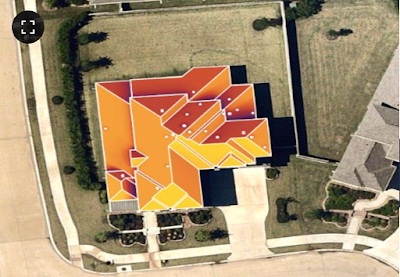
     
    Heat map - yellow = most exposure = most efficient; dark orange = least exposure = lease efficient


  • Some solar companies can only build you a system that does not exceed 10% of your power utilization. They use the previous year's energy bill and consumption in kilowatt hours as a guide. 
    • I take issue with this because the older your home gets, the less efficient it is. Additionally, if you had problems with energy consumption in the past year, your data may not be as accurate. A system built today may not be appropriate for your usage in 5 / 10 / 15 years. 

  • Unless you live on a farm or out in the middle of no where, you have to remain connected to the energy grid. A battery is really only good for storing energy in case the power goes out. I learned that if there is a power outage, because you are still connected to the utility and the solar power feeds the utility lines automatically, if there is a power outage, the solar system shuts down automatically. So there's not really an option to be living a battery-powered life. In any event, a single battery costs about $9-15k. So tack that on to the cost of your system. And likely, you will need more than 1 battery if your home exceeds a certain size. 

  • The cost of the system itself depends on the amount of energy you will need to create and the amount of space that you have to lay out solar panels to create and store that energy. In general, the bigger the house, the more energy consumed, the more panel you will need. 
In our case, we averaged somewhere in the range of 1500-2000 kilowatt hours of consumption over the past year which ranged in cost from $175 to $225 per month. The solar panels necessary to run our home at this rate would cost us about $36,000 for the panels alone, and that's paying it up front (not a loan) and getting the 26% federal tax credit (which comes when you file your tax return). So the cost of cash out the door on day one is really +/- $48,000 and then you have to wait to get your credit when you file your tax return. If I added a single battery, the cost would be an additional $12,000; two batteries would cost $19,000 (both before tax credit). 

There are other options that the solar companies offer. The one that draws the most attention is the $0 due at signing / no cost today. Essentially what happens is you can finance the cost of your system over 10 or 20 years. The interest they charge is 2.99% for 10 or 4.99% for 20 years. And you, instead, have a monthly payment to make to the solar company rather than the utility. So you end up paying more, obviously. The $36,000 system will cost roughly $44,000 by the time you're done paying it off.

My first issue with this is if I wanted to finance the cost of my solar panels, the better option would be to take out a home equity loan or borrow against my home. With interest rates so low these days, I'd get a better deal that way. 

My second issue with financing is if you choose the longer option at 20 years to avail of a lower monthly payment, by the time you're done paying for the system you've reached nearly the end of the life of the panels. By that time, you'll have to replace panels or worse yet replace the entire system. Have you really saved any money then? Or are you just breaking even? 

Also note: solar panels are not a home improvement. They are considered tangible personal property and not a fixture of the house. That being said, they do not improve the value (financially) of your home. In fact, if you wanted to take the solar panels with you to your next home, in theory, you could. But solar companies still advertise that having a solar system will increase the value of your home. I suppose it could, if the buyer of your home was willing to purchase the panels from you, but they could easily say they love the house but not the panels and have you remove them before you sell. In which case, you've got to shell out the money to have them taken down, and then there's no guarantee that they'll fit on the new home you're moving into. 

My problem now is one that's moral and ecological. While I know that becoming self-sufficient from an energy perspective will help the environment and that installing these panels would be doing our part in "saving" the world, my financial logic is at war with my conscience. I cannot justify the cost mathematically. The cost vs. (financial) benefit is about even. But the (financial) cost vs. (climate change) benefit is heavily in favor of adopting a solar energy system. 

Have any of you gone down this decision path? If so, please feel free to share your insights. And if I've gotten anything wrong up there, please help me understand so that I can correct my thinking. Many thanks! 

Sunday, December 10, 2017

Is There A Way To Encourage Healthy Eating (and Living)? - The Shock Of A Lifetime


Is there a way to flip the pricing / cost of healthy and non-healthy food to make the good stuff cheaper and the bad stuff more expensive so that we can eat healthier without worrying about cost?

It's a matter of supply and demand, I know. But will we ever get to the point where the demand for healthy, organic foods is greater than the demand for over-salted or high sugar content processed foods? Or will the supply for good-for-you food ever surpass the supply of off-the-shelf, ready-to-eat packaged goods? 

I have no idea really, but I'd hope that something drastic happens in my lifetime.

Here's an example of something that bothers the heck out of me.

Strawberries.

Amazon Fresh has 1 pound of regular strawberries for $3.99, while they carry organic strawberries for $5.99. You have to pay a $2 premium to eat better quality food.


I think it would take an enormous one-time shock to the systems (financial / economic / agricultural, etc.) for anything to change.

There has to be a way. So what if, for example, organic fruits and vegetables were produced in mass and the price could be driven as low as other non-organic fruits and vegetables? Then in theory, the demand for organics could potentially be what non-organics are currently. At the onset, obviously, the supply wouldn't be enough to feed the masses. But after a potential spike in cost until farmers could supply the demand, prices would come back down to affordable, reasonable levels. 

Or what if farmers just stopped producing non-organic fruits and vegetables all together? What if everything was organic? Again, it would be a temporary shock but the end result would be what I'm looking for. Mass produced, organic fruits and vegetables at inorganic prices.

Regular bagels
Whole Wheat bagels
Stepping away from the organic / inorganic conversation, how about just making a decision between healthier options of the same product? Let's take breakfast for example.

Bagels. If you're from the Northeast, you know this is a staple breakfast item. Whether you buy it from your local bagel store, a street vendor, or your local grocery it rarely disappoints.

For a 6-count package of Thomas' plain bagels on Amazon, you would need to pay $3.49. Add some Philadelphia Cream Cheese, a regular 8oz tub, and that's another $2.99. All together, that's $6.48. But if you so happened to be in a healthier mood and wanted to trim some fat and eat whole grains, your option would likely be for Thomas' 100% Whole Wheat bagels and the 1/3 less fat version of cream cheese. A 6-count would be $4.94 and the 8oz tub is an additional $4.39. The total comes to a staggering $9.33. That's a premium of $2.85 to eat a marginally healthier meal (see the nutrition labels). 


Regular cream cheese
1/3 less fat
What about McDonalds? Let's take a look at 2 sandwiches that they offer and compare the relative healthiness and cost. The All-American Double Cheeseburger versus the Artisan Grilled Chicken Sandwich. We all know that chicken is leaner; grilling is better than frying; white meat is better than red meat. The chicken sandwich sits on McDonald's menu at a price of $4.39, while the double cheeseburger is a value-meal at a measly $1.69! 

And take a look at these nutrition facts. Clearly the Artisan Grilled Chicken is a better choice for health purposes. But of course, it's at a premium. 

Artisan Grilled Chicken Nutrition Facts

Double Cheeseburger Nutrition Facts

Alternatives to regular, unhealthy food are the key to a healthy living. But healthy options are, unfortunately, more expensive in the marketplace. When good food becomes the primary sustenance, the cost relationship should flip. 

Sadly, I find this predicament true of not just the food industry but also the energy industry (alternative / renewable energy > fossil fuel). There are plenty of other situations, industries, and products where the current "alternatives" are better for people and the environment but are more expensive than regular products. Clearly, we need change. 

If we really wanted to encourage healthy eating, we'd find a way to make it cheaper and require less cost-benefit thought. Good food should be a no-brainer. But how can we make alternatives the primaries? 

Maybe like the heart attack that jolts a man to changing his poor eating and healthcare habits from bad to good, a sudden shock to our financial, economic, and agricultural systems is all we need to drive a healthier lifestyle going forward. 

Monday, October 9, 2017

Technology Saves The Day Almost Every Day

How many times have you realized that without some form of technology you would have been lost, at a disadvantage, or unable to complete what you initially set out to do? For me, this happens more often than I'd like to admit. Many people these days can't go for extended periods without their phones. These are our modern day saviors. The pocket-sized electronics have nearly become an appendage to most of us and a lifeline in many senses of the word.

I was reading the news today and I saw this headline:
"Google to use balloons to provide Puerto Rico cell service" - Reuters
and I thought to myself, that's genius. They've done this before. It's worked fairly well. It's quick to launch and implement. And most importantly, it solves a problem that otherwise would take weeks or months to resolve. In the wake of the numerous hurricanes (due to climate change) the Caribbean has seen this year, unprecedented damage has been left. It's been nearly 3 weeks and as of yesterday, only 8% of the island has electricity and 83% of cell sites remain out of order. Cell service, I'm sure, is not at the top of their list (although it might be close in this tech age) but at least some kind of solution has been offered up albeit temporary.


The article also mentioned a separate matter where Elon Musk was providing assistance from Tesla in the form of providing batteries to Puerto Rico. Yet another technology wonder coming to the aid of the devastated island. And in my news feed, I saw this:
"Elon Musk says Tesla's batteries could replace Puerto Rico's electrical system" - Business Insider
That would be revolutionary, I thought. And then in reading the article, I learned that it's been done before. The island of Ta’u in American Samoa uses solar energy powered by a Tesla microgrid. Tesla also built a massive solar farm on the Hawaiian island of Kauai that can account for 20% of the island's peak electricity load. Amazing! And the, unfortunately, clean slate in Puerto Rico really gives an opportunity to see how well this kind of thing would work on a more populated island nation and really in more a first-world situation. It could very well be the testing grounds for scalability. If it works well in Puerto Rico, that could signal changes for any other American city willing to overhaul the infrastructure and clean up the environment.


A few days ago, I whimsically came up with my own idea of improving our lives and helping the environment through technology. I jokingly tweeted that the roofs of cars should be solar panels and proceeded to tag as many car companies as possible.
 Have you ever seen a commuter parking lot on any given day? Here, let me show you:


Imagine if all those roofs were solar panels? Cars just sit around all day baking in the sun. Even if you were driving around on a clear sunny day, you could be charging yourself. Think about all the juice you'd be storing just from parking in at the supermarket to do some grocery shopping. The real setbacks are in locations that don't get great sun all year round, but that's where the charging stations come in. And covered parking garages could have charging stations too. But otherwise, what are the downfalls of having a solar panel on the roof of your car? (637)