Showing posts with label Technology. Show all posts

Saturday, February 12, 2022

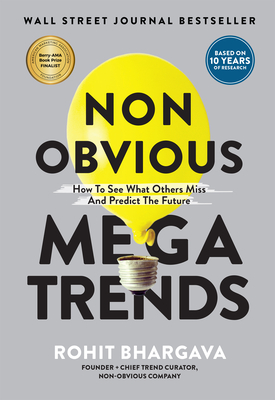
Non Obvious Megatrends: How to See What Others Miss and Predict the Future by Rohit Bhargava

When you pick up a book in a series, the biggest fear is that you won't be able to fully appreciate references that are made in the latest edition. That is definitely not the case here as the Non Obvious series is crafted in such a way that there are recaps to support the continuation of trends that weren't so obvious in the past. You get a glimpse at the genesis and evolution of ideas, the divergence in the paths from the old trend, or the support and building blocks to the current trend. The book allows you to imagine how things may play out or fizzle. 

While the collection starts with the methodology in seeking out or identifying trends, the heart of this book consists of Bhargava's current thoughts on trends that we're unconsciously following and contributing to in society. And the tail end recaps and assesses the past identified trends, whether they survived or flopped or took an alternative route and nevertheless blossomed into something else. 

I enjoyed this book for the easy read it was and the hints at what to look for in trendsetting across a variety of industries / subjects. I think this book will really hit hard for the creatives and analytics in our lives. Designers, marketers, advertisers, investors, retailers, and people interested in the possibilities of our future will find a topic to cling to and see out. 


Check it out on GoodReads. 

Buy it on Amazon. 

Wednesday, February 2, 2022

The Future Is Faster Than You Think: How Converging Technologies Are Transforming Business, Industries, and Our Lives by Peter H. Diamandis & Steven Kotler

I've been thinking about the future a lot lately. You may have noticed a couple of the books I read last year were about the future (The Storm Before the Calm: America's Discord, the Crisis of the 2020s, and the Triumph Beyond, 2030: How Today's Biggest Trends Will Collide and Reshape the Future of Everything, and How to Avoid a Climate Disaster: The Solutions We Have and the Breakthroughs We Need). My interest was mostly driven by my want to become a better investor but also my curiosity about what changes should I expect / anticipate and prepare for. This is another title to add to my collection of "books- that-I-read-during-the-pandemic-because-the-future-seems-uncertain."

Seriously. The Future is Faster Than You Think couldn't be a more apt title. Getting through this book made me more aware of some of the technologies that are already available, maybe not commercially yet, but certainly out there. Given the exponential growth in technology and the development of our understanding and capabilities, I would not be surprised if many if not all of the ideas / thoughts detailed here become available to the common person in our lifetime. 

What's really more interesting than the ideas and products are the ways in which they come together to change the world. In what the book describes as convergence, the overlap of what we dream up, what gets created, who it's available to, when it's available, what it improves or solves, and how it changes our lives personally / economically / politically is what makes this read hard to put down and compelling. 


Check it out on GoodReads. 

Buy it on Amazon. 

Friday, October 27, 2017

2017ers - Digital Diggers For The Technology Era

It's official. I'm a miner!

This is my crypto-commodity.

Similar to the 49ers who mined for gold in 1849 (the namesake referring to the year the gold rush began), I am now involved in mining for Ethereum. Is it fair to call us 2017ers, the believers and pursuers of cryptocurrency - in this case, Ether?

Regardless of what monicker we go by, we are the technology era's digital diggers. For those of you who are not familiar with Ethereum or cryptocurrency, let me try to break it down. Cryptocurrency is digital money. And Ethereum is one of the currencies available for use. It's the 2nd most recognized and popular digital coin; the first being Bitcoin. It's similar to the physical, paper fiat currencies like the US Dollar (USD), the British Pound (GBP), the Euro (EUR), the Australia Dollar (AUS), Chinese Renminbi (CNY), or the Japanese Yen (JPY) - but it's digital. Currently, the value of Ethereum against the USD is 1 ETH = $295.94 USD as of the time of this writing.

The real beauty of Ethereum is the background technology called Blockchain. I've talked about this before briefly. For me, the long and the short of it is that Blockchain will be the future of every industry conceivable. It's a general ledger system for data (blocks) that are linked (in chain fashion) and secured using cryptography. I relate this to the function of Accounting. Every person or business needs a good Accounting system. This could potentially be the best one ever designed. That being said, it's application is versatile and comprehensive.

For more on cryptocurrency and Blockchain, check out the ultimate guide here.

Getting back to my original point. I'm a miner! How?

Digital currencies are mined, not created or printed. In order to "mine" the "coins" or "tokens" complex computers are built and process extremely difficult maths problems. The machine who cracks the problem is considered to have "mined" the block and is awarded some portion of or the full value of the currency being mined. For a better explanation of the mining process, see here. 

That being said, I made an investment for an interest in a mining machine and will begin to collect Ether on a daily, weekly, monthly basis. Of course, like any other investment, there are maintenance costs along the way. So the hope is that the value of Ether against the USD will continue to climb to be well in excess of the operating costs.

My prediction is that cryptocurrencies will be here for the long run, and that eventually we will see it integrated into society and find it more and more as a payment method both online and in brick and mortar. It's ease of use and security will be the new gold standard of payment processing.

I'm in it for the long haul. Who's with me? (476)

Monday, October 16, 2017

eSports Is On The Rise


Last night I started to read about something new to me but not new in general. eSports. Kids and many of today's adults play video games. (I say "today's adults" because they are the generation that pioneered gaming systems 30-40 years ago.) And in the recent years, the video-gaming industry has turned what was once friendly competition into a money-making, competitive, league-forming battlefield.

Players are now considered "professional" depending on their "skill" level at beating their enemies or completing tasks / levels. And there are many, many players out there. So many, in fact, that tournaments are organized and bring hundreds if not thousands of players. But most significantly, the events bring spectators, enthusiasts, amateurs, and others to watch the fast-paced motion graphics on big screens in arena-sized locations. We're talking about millions of people involved here. eSports are taking on a life very similar to real life physical sports (NFL, NBA, MLB, NHL, MLS, etc.).

And the prize money is not insignificant. This is a link to the Top 100 games with the most prize money awarded over time. Clearly, there's plenty of cash to motivate players to improve their gaming abilities to be good enough to compete.

I suppose it's no real surprise that the money is there. I mean simple investment strategy tells us that you have to put money in to get money out. That is, you have to buy the equipment (games, consoles, controllers, graphics cards, microphones, headsets, etc.) to put in the time and practice, and once you've achieved that certain player level, you might reap the rewards monetarily. How good you are determines your Return On Investment (ROI).

But now that there are established tournaments all over the world and the frequency with which they happen is often, the idea of creating leagues and teams for profit must have been tugging at the purse-strings of investment related mindsets. It was just a matter of figuring out how to monetize the industry. And now it's been done.

The industry has been growing for the past couple of years already. Expectations are for the size and wealth of the players, investors, gaming designers, software companies, hardware manufacturers, and all the other peripheral positions is growing exponentially. Actual franchise teams are investing in their eSports teams. Even celebrities are getting in on the action. And it clearly makes sense. The investment is relatively cheap, the target market is growing (in population), and the returns are proven.


The target market grows in so many ways too. You have the gamers and spectators on the high side of the age range who continue to age (obviously) but with that comes more disposable income. And since they're already locked into the mindset, it's natural to continue to support something they've "grown" with. On the other side of the spectrum are the kids who are entering the gaming age. We know that there are millions of kids born each each. That just means the chances of developing a fan, a gamer, or an investor in the future is pretty good.

And technology is constantly improving. We're getting better computers, improved graphics, and faster internet everyday. The world is becoming smaller, faster, and more capable all the time. This all makes the gaming industry that much more capable of supporting the inevitable gold-rush-like boom that will continue for the next few years.

I'm very interested to see where this goes, both in the short term and the long term. As one of today's adults, it will be one of those things that we'll look back on and say, "I was around and conscious of it all when this movement started." And my hope is that I too can get in on the action in the near future and make a future for myself with that. Anyone want to take a risk too? (641)


Monday, October 9, 2017

Technology Saves The Day Almost Every Day

How many times have you realized that without some form of technology you would have been lost, at a disadvantage, or unable to complete what you initially set out to do? For me, this happens more often than I'd like to admit. Many people these days can't go for extended periods without their phones. These are our modern day saviors. The pocket-sized electronics have nearly become an appendage to most of us and a lifeline in many senses of the word.

I was reading the news today and I saw this headline:
"Google to use balloons to provide Puerto Rico cell service" - Reuters
and I thought to myself, that's genius. They've done this before. It's worked fairly well. It's quick to launch and implement. And most importantly, it solves a problem that otherwise would take weeks or months to resolve. In the wake of the numerous hurricanes (due to climate change) the Caribbean has seen this year, unprecedented damage has been left. It's been nearly 3 weeks and as of yesterday, only 8% of the island has electricity and 83% of cell sites remain out of order. Cell service, I'm sure, is not at the top of their list (although it might be close in this tech age) but at least some kind of solution has been offered up albeit temporary.


The article also mentioned a separate matter where Elon Musk was providing assistance from Tesla in the form of providing batteries to Puerto Rico. Yet another technology wonder coming to the aid of the devastated island. And in my news feed, I saw this:
"Elon Musk says Tesla's batteries could replace Puerto Rico's electrical system" - Business Insider
That would be revolutionary, I thought. And then in reading the article, I learned that it's been done before. The island of Ta’u in American Samoa uses solar energy powered by a Tesla microgrid. Tesla also built a massive solar farm on the Hawaiian island of Kauai that can account for 20% of the island's peak electricity load. Amazing! And the, unfortunately, clean slate in Puerto Rico really gives an opportunity to see how well this kind of thing would work on a more populated island nation and really in more a first-world situation. It could very well be the testing grounds for scalability. If it works well in Puerto Rico, that could signal changes for any other American city willing to overhaul the infrastructure and clean up the environment.


A few days ago, I whimsically came up with my own idea of improving our lives and helping the environment through technology. I jokingly tweeted that the roofs of cars should be solar panels and proceeded to tag as many car companies as possible.
 Have you ever seen a commuter parking lot on any given day? Here, let me show you:


Imagine if all those roofs were solar panels? Cars just sit around all day baking in the sun. Even if you were driving around on a clear sunny day, you could be charging yourself. Think about all the juice you'd be storing just from parking in at the supermarket to do some grocery shopping. The real setbacks are in locations that don't get great sun all year round, but that's where the charging stations come in. And covered parking garages could have charging stations too. But otherwise, what are the downfalls of having a solar panel on the roof of your car? (637)

Friday, October 9, 2009

Technology

It's an amazing thing. One day we're typing in each others' information and the next day, we're scanning their bar codes. Stay in touch...