Showing posts with label Business. Show all posts

Wednesday, February 2, 2022

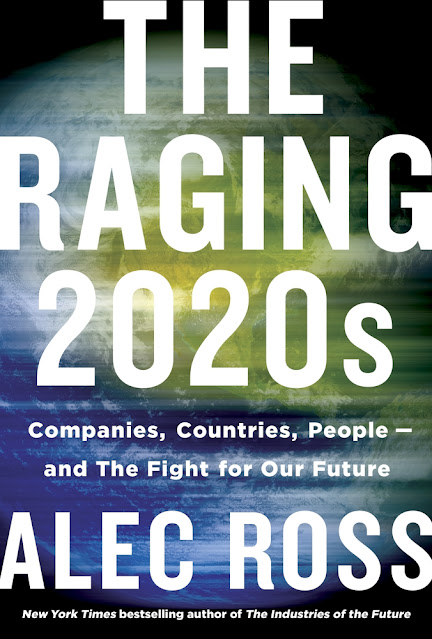
The Raging 2020s: Companies, Countries, People—and the Fight for Our Future by Alec J. Ross

I read this book along with The Future Is Faster Than You Think simultaneously and thought it was the best decision I've made in 2021 thus far. While the latter gave us thoughts about convergence in the future, this book attacked the future with a tint of history. It's written with a cause and effect premise examining the economic and political factors of the past to get us to where we are now with a look at what could be of our future if things do or don't change. 

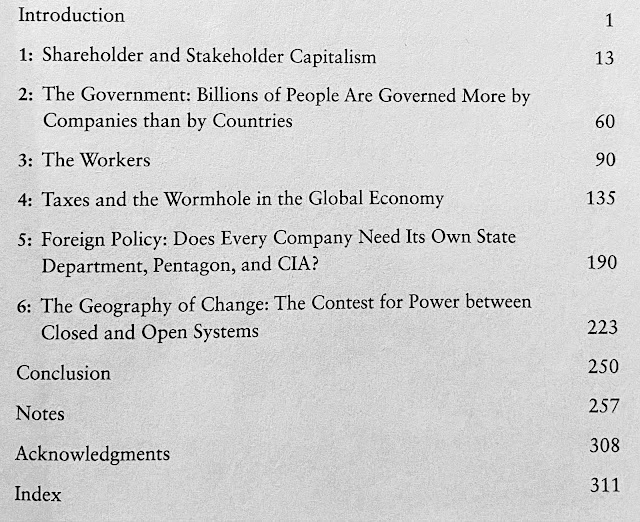
A simple look at the table of contents hints at the direction the book endeavors to take, but a thorough appreciation for the contents will reveal insights about our present in hopes of making the future brighter. The only thing certain is that change is necessary. The questions are, "How?", "When?", "What will it take?", and "Who's in?"


Check it out on GoodReads. 

Buy it on Amazon.

The Future Is Faster Than You Think: How Converging Technologies Are Transforming Business, Industries, and Our Lives by Peter H. Diamandis & Steven Kotler

I've been thinking about the future a lot lately. You may have noticed a couple of the books I read last year were about the future (The Storm Before the Calm: America's Discord, the Crisis of the 2020s, and the Triumph Beyond, 2030: How Today's Biggest Trends Will Collide and Reshape the Future of Everything, and How to Avoid a Climate Disaster: The Solutions We Have and the Breakthroughs We Need). My interest was mostly driven by my want to become a better investor but also my curiosity about what changes should I expect / anticipate and prepare for. This is another title to add to my collection of "books- that-I-read-during-the-pandemic-because-the-future-seems-uncertain."

Seriously. The Future is Faster Than You Think couldn't be a more apt title. Getting through this book made me more aware of some of the technologies that are already available, maybe not commercially yet, but certainly out there. Given the exponential growth in technology and the development of our understanding and capabilities, I would not be surprised if many if not all of the ideas / thoughts detailed here become available to the common person in our lifetime. 

What's really more interesting than the ideas and products are the ways in which they come together to change the world. In what the book describes as convergence, the overlap of what we dream up, what gets created, who it's available to, when it's available, what it improves or solves, and how it changes our lives personally / economically / politically is what makes this read hard to put down and compelling. 


Check it out on GoodReads. 

Buy it on Amazon. 

Thursday, January 21, 2021

Sam Walton: Made In America by Sam Walton, John Huey

Humble beginnings. Sam Walton's Made in America is the epitome of that phrase. This was a great story about an all-American, hard working, considerate, and passionate man. It's proof that drive, perseverance, and the ability to learn from your mistake and adapt are keys to being successful. 

I learned so much about Walmart from reading this. And I don't think I'm alone in saying that my perception of Walmart was that of a budget type organization with low standards. But after reading this book, I have a new appreciation for the type of business the family runs. And my thoughts about the quality and standards of the company are certainly now different. I admit, it was ignorant of me to have thought anything negative of Walmart without knowing any better. And for that I apologize. 

What I learned is a principal business practice that makes so much sense. And the scale at which it is accomplished by Walmart is a feat that should be admired, and is evidently admired by the economy and the patrons of this Superstore - and now me as well. That practice is sacrificing the huge markups on retail goods to sell more quantity and of passing on the savings to your customer. It's so simple but so powerful. 

If Walmart can buy an item for a $1 and sell it for $1.25 and sell 100 units, then their gross receipts are $125 with a cost of $100 and profit of $25. If a competitor sells the same product with a markup of 30% instead of 25%, and can only sell 90 units - the gross revenue is $117 making profit only $17. But I bet the competitor who sells for just a 5% greater markup loses more than just 10 units to Walmart, making their profits significantly less than Walmart's. 

While the business appeals mostly to those looking to save money, that doesn't mean the quality of the products they sell or the relationships they have with their vendors and others is any different or less valuable / important than another chain's quality / relationships. In fact, they might even be better in some ways. 

I have plenty more respect for Walmart, the organization, the employees, and the consumers of their products than I did before - not that I was ever disrespectful, but I just looked at it differently. 

I think the most important lesson I learned from this is, again, that you can't judge a book by it's cover. You've got to read between the covers to unearth the truth, the realities, and the things you wouldn't have known otherwise. 


Check it out on GoodReads. 

Buy it on Amazon.

Thursday, December 10, 2020

This Changes Everything: Capitalism vs. The Climate by Naomi Klein

 Comprehensive. 

Through 2014, this is certainly the word I'd use to describe the way this book was written. This Changes Everything: Capitalism vs. The Climate examines seemingly almost every aspect of climate change. Naomi Klein's research is extensive and global. The causes, effects, potential, the conflicts, possible solutions, the ideas and failure, the who / what / where / when / why if everything that climate change touches is addressed in her writing. She even gets personal, and that's the most heart-wrenching part. Because it's easy to see climate change as an existential crisis, it's easy to just set it aside in your everyday life. But once it hits you, once you're affected and cannot avoid the direct impact and parallels, your personal life will never be the same. 

I loved this book for how it addressed everything that I ever thought about and more about climate change. The exposure to different lines of thought and possible outcomes was insightful and sometimes anger-inducing. 

And after reading it all, if someone remains unconvinced that climate change is real and that actions need to be taken, then that person is unfortunately delusional. For me, this was further proof and knowledge about the goings-on of climate change. And I wonder what Klein would add to this since 2014. Obviously many things have changed, and more change is coming in 2021 with a brighter outlooks. I'm anxious to see how climate change and our reactions will guide our future. 


Check it out on GoodReads.

Buy it on Amazon. 

Tuesday, August 18, 2020

Prediction: Eye Contact Failure

The world's exponential use of Zoom, Microsoft Teams or any other remote computing collaboration software for the work environment highlights the need to be visible and helpfully personifies a voice from a distance. While it's easy to just be on camera and speak when called upon or participating in the conversation, what's hard is maintaining eye contact with your audience. 

In some ways, it's almost as if you're on stage, not addressing any one person, but a group of people, in which situations the most often heeded guidance is to look over their heads to avoid the feeling of nervousness. (On the other hand, speaking in front of these small groups still gives us the practice of public speaking.)

In one-on-one conversations, it's become too easy to avoid eye contact. Our vision is constantly distracted, whether it's our cell phones, a second / third / fourth monitor, or a family member crossing your field of vision. We hardly have real eye contact anymore. Even if it looks like you are face-to-face, the other person could easily just have your video minimized and could be staring at something else on the screen; it just so happens that the camera is on that screen. 

I predict that once we go back to working in-office, our newly formed habits will overrule our once professional routine of locking eyes with our conversation partners. We will seemingly be distracted in the face of our colleagues, our eyes constantly wandering over their shoulders, looking down, peering at our phones, or if close enough to our desks, starting at our monitor while trying to carry a conversation. 

I'll tell you now that this bad habit needs to be kicked. So practice being engaged with your counterparts on-screen now. Close your other windows. Minimize your distractions. Fully immerse yourselves in whom you are working with. Connect visually, not just audibly. You'll be more productive that way too. 

Just because we're working remotely, doesn't mean we have to sacrifice our in-office etiquette. 


Thursday, October 19, 2017

Get Your Umbrellas Out Because I'm About to Brainstorm (Again)


While I'm on the topic of investments, I recently had a recollection of all the random ideas I've had in the past that never made it anywhere. For a while, I "invested" my time in developing some concepts that I hoped would make it big someday. The names needed to be short and catchy; the domain name had to be available and memorable. The product or service had to be something people would be interested in, and at the time I thought that was enough. Little did I know that the product / service also needed to be needed and solve a problem. (I know these things now because I watch Shark Tank religiously.)

Then I registered the domains, created the administrative email accounts, setup a Google Suite account, and if the idea was good enough - I recruited a small team to help, created a website, FB page, Instagram, and Twitter account. Of all the ideas that ever completely made it down that path, there were only two - my own blog and DrunkEats. But the vast majority of other thoughtful possibilities only got domain names. And even with that, the names and ideas were a stretch away from anything remotely possible.

But there is one idea that I constantly keep at the forefront of my imagination hoping I could further develop it and one day be smart enough to have others back it. I mean, I think it's good but its not unique enough. (Although the slogan we came up with is fantastic. Haha.) Anyway, a discussion about the service-oriented business idea resurfaced recently in a conversation with a friend who is currently going through his own newly created (but certainly thought about at length) brand development.


As I described to him the concept behind the name and could-be business idea, he chimed in with enthusiasm, even adding fuel to the gently stoked campfire burning in my mind by contributing some ideas and thoughts about it. We talked about blogging, branding, marketing, and direction. And at the end of the phone call, I told myself that I'd have to jumpstart the idea again with the team I previously enlisted many years ago when it all started. Of course, I'd want to involve my friend somehow because the more, the merrier but also the better the ideas become with more people to help it along. (396)